The Fall Indoor Circuit

The Pennsylvania National Horse Show just finished 10 days showcasing premier hunters and jumpers ridden by juniors and adults, all culminating in the $85,000 Grand Prix de Penn National. I watched nearly ever round of every class thanks to live streaming on the USEF Network (www.usefnetwork.com) the online channel of the United States Equestrian Federation (USEF). Thanks to technology horse-crazy girls like myself can experience equine sports to the extreme from the bending lines, in and outs, and long approaches of those exquisitely executed hunter courses to those thrilling triple combinations, rollbacks, and jumper jump-offs. To my delight I also watched Hunt Night, complete with a pack of hounds and the Ladies Side Saddle division, including jumping! Think about that for a moment.

Horse Show of the Gilded Age
Premier horse shows, like dog shows, grew up in Manhattan’s gilded age in the 1870s and 1880s. The famous Westminster Kennel Club dog show, founded in 1877, which promotes itself as the second longest sporting event in America after the Kentucky Derby, was founded by a group of sportsmen. So too was the National Horse Show founded in 1883 by a group of sportsmen. And while horse sports, in the form of racing was established much earlier, with such venues as the Saratoga Race Course in 1863 during the Civil War, it was the post-war economic boom which fueled incredible wealth and the need to spend it on leisurely pursuits.

At this point those gilded gentlemen and their ladies, needed some entertainment and bragging rights to amuse themselves during the rest of the year when they weren’t up at the “Saratoga Spa” but stuck in New York City for the fall and winter social seasons. Both Westminster and the National Horse Show chose the original Madison Square Garden at 23rd Street and Fifth Avenue as the venue for the premier events in their respective sports.

“The National” became “the place” to be seen. In fact, according to the event’s website, “By 1887, the National Horse Show Directory, listing directors and 920 members, formed the basis for Louis Keller’s first New York Social Register.” Even The New York Times journalist Joe Drape gave a nod to the social status of the National when recounting the racehorse Cigar, “to his final destination of Madison Square Garden, where on Nov. 2, 1996, he was thrown a retirement party before the white-gloved set at the National Horse Show.”

As the popularity of equine sports soared after World War II the National had company. The Pennsylvania National Horse Show was founded in Harrisburg in 1945 followed by the Washington International Horse Show (WIHS) in 1958 in DC. These three top-rated urban horse shows held in large indoor arenas a few weeks apart in October were dubbed “the indoor circuit” or “fall indoors” for the last half century.

Horse-Crazy Girls
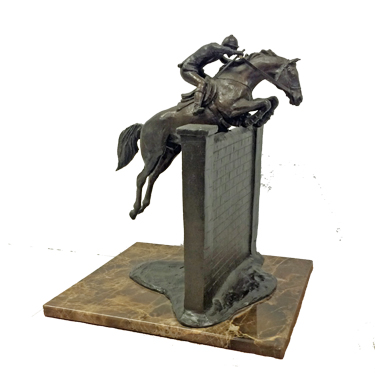
I recall my first trip to the National as a young child mesmerized by something called the Puissance. This class basically asks a horse to gallop at a 7-foot brick wall made of wooden boxes and jump it. I also remember watching the Maclay Equitation Finals because a fellow rider at my barn was showing her sister’s beautiful black Thoroughbred mare Fleet Nancy, a relative of 1943 Triple Crown winner Count Fleet. I also remember another young girl who won that class, Leslie Burr, who hailed from Connecticut. It was at that show I fell in love with horse shows, jumping and Thoroughbreds!

Last week I watched that same Leslie Burr, now Howard, pilot many jumpers around the Farm Complex at the Penn National via live stream. It was a different kind of thrilling than some 40 years earlier at the Garden, but still, today I could watch it where ever I was! And, Olympic veteran Howard keeps those beautiful horses right here in Newtown.

This week I’ll be tuning in to watch the WIHS, which now bills its self as ‘the country’s leading metropolitan indoor horse show,” since the venerable National left Madison Square Garden in 1990s. Indeed, the WIHS has other bragging rights as well, including “The standing North American indoor Puissance (high jump) record of 7 feet 7 1/2 inches was set at Washington in 1983 by Anthony D’Ambrosio and Sweet N’ Low.

And to finish up the indoor circuit October 28-November 2, the Alltech National Horse Show can be viewed online from USEF’s headquarters at the Kentucky Horse Park, the show’s home since 2011. It pleases me to know that the National, at one point near extinction once it left New York City, was a tradition founded and saved by a “group of sportsmen” and sportswomen too!

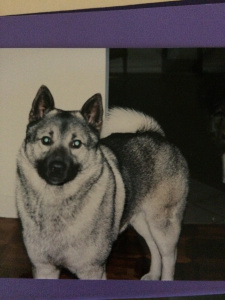
My First Canine Good Citizen Dog: Bruno the Norwegian Elkhound

In honor of AKC’s Canine Good Citizen program turning 25 years old, I unearthed my first CGC certificate in my canine archives. Good Job Bruno!

americankennelclub's avatarAKC Dog Lovers

By Lisa Peterson

Bruno

Bruno and I were minding our own business on a walk around the hotel at the Norwegian Elkhound National Specialty in 1996 when a friend spotted us and said, “Hey, come take the Canine Good Citizen test, it’s right over here.” I had no idea what this was, in fact, I didn’t even know the 10-steps prior to signing up for the challenge. Bruno – an AKC Champion who had just turned 4 – and I had been training to start Novice obedience a few months earlier, so I though why not, he can sit and stay and heel.

We entered the ring ready to begin. I got nervous. Bruno took one look at me with his big brown cow eyes as if to say, “What’s the big deal? I can do this.” And off we went. The more steps we completed, the more fun Bruno…

View original post 252 more words

19th century foxhounds

The Roosevelts: Celebrated Dogs of America

While binge-watching Ken Burn’s historic PBS series The Roosevelts last week, a photo of Theodore Roosevelt and his hunting dogs triggered a thought; there is a meeting room in my office called the Roosevelt Room. I knew the collection of sporting dog prints and detailed pedigrees that graced the walls had something to do with “Teddy” but after a decade of sitting through countless meetings starring at these prints, their origins had been lost on me. So I took a recent lunch break to revisit the treasures of the Roosevelt Room at the American Kennel Club headquarters in Manhattan.

As you turn on the light switch, you are greeted by the black ink on grey paper cover art for the collection “Celebrated Dogs of America, Imported and Native, by A. Pope Jr., published by S.E. Cassino, Boston.” Beneath the poster a framed handwritten note card from Mrs. Richard Derby of Oyster Bay, New York, dated May 1974, reads, “These prints of Celebrated Dogs of America were collected by my father Theodore Roosevelt when he was a student at Harvard in 1879.”

Pointer dog breed

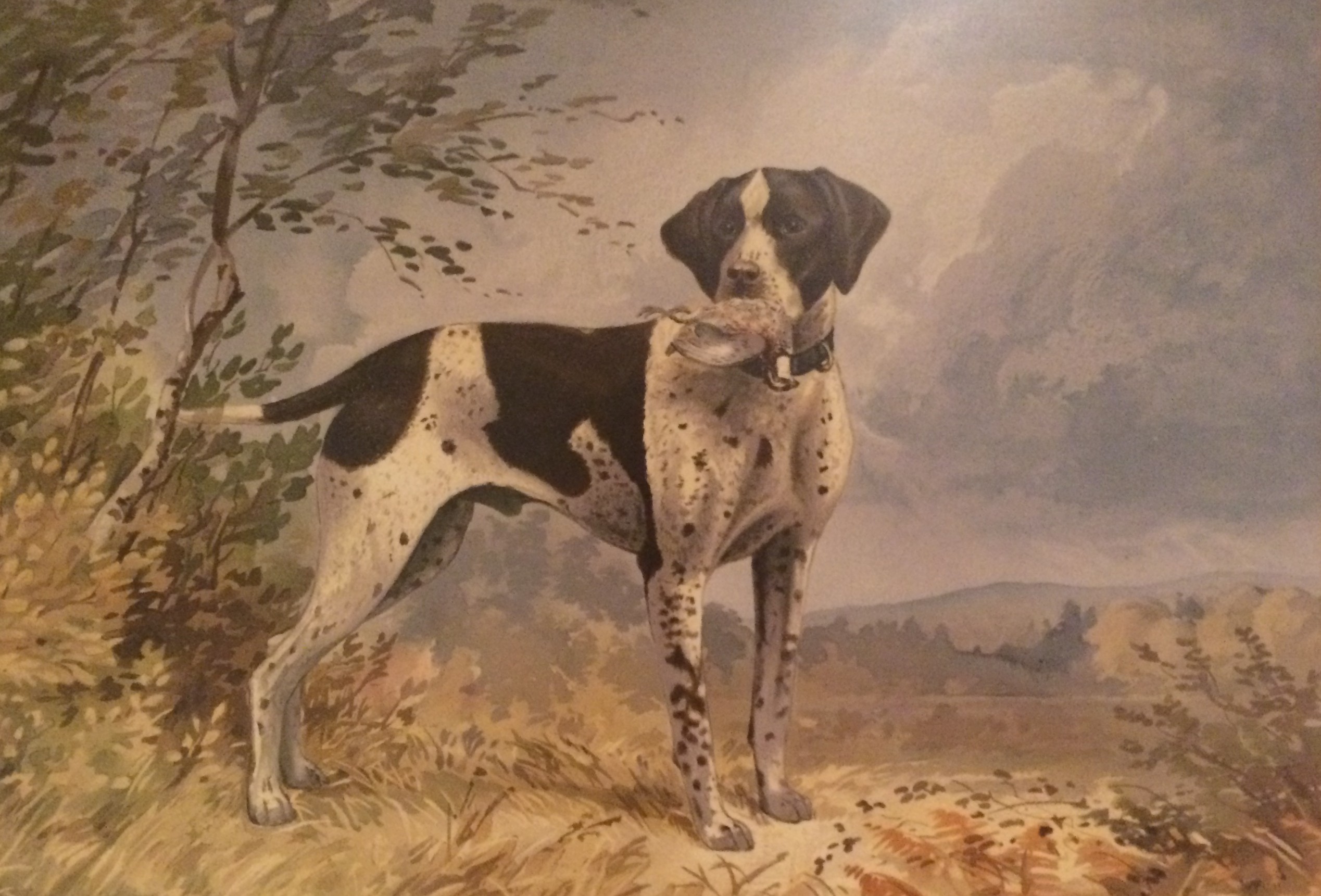
Dan the Pointer

As part of 19th century gentlemen’s society, Teddy must have not only studied, but hunted with these sporting purebred dogs. Today, the 18 muted chromolithographs of original watercolors painted by wildlife painter Alexander Pope, Jr. (1849-1924) hang in a neat row, midway up the walls, circling the room, except where their flow is interrupted by an HDTV used for video conferencing.

Celebrated Dogs of America

Who made the cut in 1879? Celebrants included a pack of black and white fox terriers named Rattler, Vixen, Tyrant, Minnie, Nettle and Daisy; the Rose Tree Fox Hunting Club of Philadelphia foxhounds, and several champion pointers including Dan, a native whelp born 1876 and owned by Mr. John G. Heckscher of New York City. Under Dan’s striking pose it reads, “Dan’s performance in the field have won him a high private reputation, and it is claimed by his friends that as a retriever he has no superior in this country. His first performance at a bench show was in Springfield in 1876, when he secured first in the puppy class, and the following year received ‘very highly commended’ at the New York bench show.”

Fox Terriers

Fox terriers Rattler, Vixen, Tyrant, Minnie, Nettle and Daisy

Trimbush, a Clumber Spaniel, whelped May 1875, had quite the pedigree. “Trimbush was bred by Mr. William Brailsford, head keeper to the Duke of Westminster, and was imported by Mr. Jonathan Tomas, jr., of New York. He is a perfect specimen of the breed and his superior could not be found in England at the time he was brought to this country.” Trimbush’s mother was Earl Spencer’s Sall, out of Earl Spencer’s Meg and Marquis of Exeter’s Beau, Beau’s sire being the Duke of Newcastle’s Rover.

Clumber Spaniel

Trimbush the Clumber Spaniel

It seems that big fancy names were not the rage back then. Take for example others in the collection, champion Red Irish Setters Elcho & Rose, Don the smooth-coated St. Bernard, Mike, the imported Irish Water Spaniel, Lofty the Llewellyn Setter Dog, Jack, the English Mastiff, and the white Bull Terriers, Spider, Grabb and Nellie, whose likenesses silhouetted against farm fencing made a pretty picture.

Bull Terriers

Bull Terriers ~ Spider, Grabb and Nellie

Historical Hounds in History

Some dogs had famous owners, like a pair of greyhounds named Tippecanoe and Prairie Girl. “Tippecanoe was a white dog formerly the property of General Custer and is a grandson of a great dog named Master McGrath.” Under the print a letter dated April 12, 1879, three years after Little Big Horn, from Mrs. Custer reads, “ Sir, I regret to say the pedigree of the imported hound General Custer received from Scotland has been mislaid among the papers in our home in Monroe, Mich. The pedigree of the dogs sent him from Canada we never had. I do not know whether the dog you own is from the Scotch or Canadian dog. We often had fifty in the pack of hunting hounds. I thank you for your kindness to the dog, and I am glad he has a good home. Very respectfully, Elizabeth M. Custer.”

greyhounds

Tippecanoe & Prairie Girl greyhounds

Rattler and Belle, two Beagles, owned by J.M. Dodge of Detroit came with this explanation. “Foot beagles should not much exceed nine inches in height; they are now even used up to eleven and twelve inches, going a pace which requires a good runner, in prime condition, to keep up with them.” Did Teddy ever had to keep up with these quick Beagles as they chased hares across the countryside.

Beagles

Rattler and Belle, two Beagles, owned by J.M. Dodge of Detroit

Bevis the Irish Wolf-Dog is my personal favorite. “Bevis is believed to be the only specimen of his breed in this country. He was bred in Ireland by a gentleman who has given a great deal of attention to bringing the breed back to its former excellence. (it being now nearly extinct). The dog was brought to America and shown at Westminster Kennel Club in 1879.” His description goes on to state “…The wild animals which he seemed powerful enough to conquer having long disappeared from the kingdom. The beauty of his appearance and the antiquity of his race are his only claims as he disdains the chase of stag, fox or hare.”

I wonder which dog was Teddy’s favorite? If you’d like to view the collection, drop me a line, it’s open for public viewing by appointment.

World Dog Show 2014

World Dog Show 2014

Dog shows are the best place to see a variety of breeds here in America. But seeing tens of thousands of purebreds gather from around the world requires a trip to the annual FCI World Dog Show (WDS). This year’s edition held in Helsinki, Finland, hosted by the Finnish Kennel Club (FKC) as part of their year-long 125th Anniversary celebration did not disappoint. Finland is a nation of dog lovers, avid hunters, and reindeer ranchers with 5.4 million citizens. According to the FKC, “Every fifth Finnish family owns a dog. Some 80% of these 600,000+ dogs are pure-bred. Each year, about 50,000 dogs representing more than 300 different breeds are registered in Finland.” Of those 300 breeds, only five are Finnish natives.

Finkies, Lappies & Reindeer Dogs

In honor of the FKC’s 125th, the show organizers waived the entry fee of Finnish Breeds. This brilliant public relations move created large entries of local dogs among the 21,200 dogs in attendance. An amazing 526 Finnish Lapphunds took up five of the 100 show rings one day. This friendly black and tan long-haired medium-sized dog has added to his hunting and herding roots to become a “Lapp dog.” Next up in the Finnish breed parade, an amazing 234 Lapponian Herders were entered. This breed is known for its reindeer herding ability in the northern reaches of Lappland. This breed is a smooth-coated black and tan version of the Lapphund. In fact, if you live in Finland and own property, each year the government will give you 2,000 reindeer to tend to. So you’d better have a Lapponian Herder or two kicking around to help with the herd. There were more than 100 Finnish Spitz – the national dog of Finland – with its brilliant orange dense coat, prick ears, curly tail and foxlike face.  Affectionately known as “Finkies” these “barking bird dogs” are known for their ability to flush upland game fowl for the adventurous hunter.

Another national favorite, the most popular registered native breed, the Finnish Hound, made a handsome appearance with his traditional foxhound looks of tan, black and white with long floppy ears to capture the scent of his prey of hare and fox. A Finnish Hound even competed in Best in Show. Wrapping up the natives was the majestic Karelian Bear Dog. This tall, mostly black with white accents hunter of bear, lynx and wolf, clearly demonstrated why he was classified in the Spitz and Primitive breeds group. I must have watched 75 male Karelian Bear Dogs. They are cool breed, similar to my own Norwegian Elkhounds in structure, Scandinavian spitz stature and hunting prowess, their temperament clearly remained on the primitive side.  While all dogs at American dog shows are expected to present themselves in a dignified and calm demeanor, these dogs loved to break out into snarling fighting spats in the ring. Now the handlers kept them all on a tight leash, but more than once as I sat ringside watching these magnificent creatures, I pulled my feet away from the ring as they passed, just in case!

Breeders’ Group and Best In Show

My favorite part of the World Dog Show was watching the Breeder’s groups. Each night the arena filled with teams of three to five dogs shown to represent a kennel’s bloodlines. Seeing the most consistent look from animal to animal to animal was a real thrill. Plus, they all dressed in the same costumes! From five Salukis handled by magenta bloused ladies, to four yellow dressed handlers with black Flat-Coated Retrievers in profile against them to smart burgundy suits walking with four Lhasa Apsos. Proud breeders showing off their best dogs. For more photos visit:  http://www.pinterest.com/elvemel/world-dog-show-2014-helsinki-finland/

There was much fanfare, a live band, and beautiful emcee, to finally announce that the  Affenpinscher “Tricky Ricky” (son of Joey, the Westminster Best in Show winner) won Best in Show.  But my top pick for the three-day event was meeting hundreds of native Finnish breeds. “Kittos” Finnish Kennel Club.