The Gorgeous Sourmug: 5 Ways of Looking at a Bulldog

americankennelclub's avatarAKC Dog Lovers

FOAPcute-bulldog-fa8f166e9c874245b2cb9b7476455bb8

AKC Gazette, “Times Past”:

  1. “There are some who compare the dog Cerberus, the monster that guarded the entrance to Hades, with the original conception of the bulldog. This, of course, is fanciful. Time has so molded his disposition that, today, he is as different from his past as that bloodthirsty bygone age is different from our own kindly humanity. The bulldog is the sweetest dog on earth, and to gain that epithet he has come a long way.” —Josephine Rine, AKC Gazette, April 1928

  1. Many schools and universities use the Bulldog as their mascot, but Yale’s Handsome Dan was the original. The first in a long line of Handsome Dans came to Yale in 1889. He was immortalized in the “Bulldog” fight song, written in 1911 by undergraduate Cole Porter.

When the sons of Eli break through the line,

That is the sign we hail,

Bull-dog! Bull-dog! Bow, wow, wow…

View original post 131 more words

Riding to Hounds In America

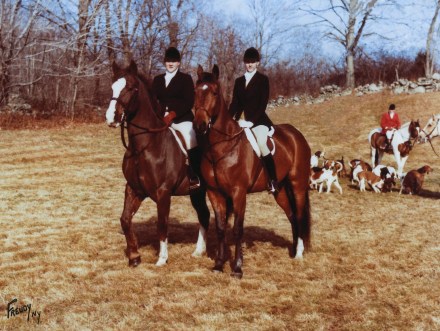
The first Saturday of October when leaves turn gold and scarlet red and the air crisp, my thoughts always turn to riding to hounds and the start of the formal season. My first formal meet gathered at Greenfield Hill Church green, where some of the Fairfield County Hounds had assembled for a Thanksgiving Day hunt. Donning formal attire, black hunt coat, white stock tie fastened with a gold pin neatly tucked under my chin and white knit gloves, I was aboard my chestnut pony Gingersnap. We took off to the sounds of the huntsman’s horn to his hounds. Soon we were galloping down country lanes, jumping stone walls and having a fine day on this “drag” hunt. The pack had come down to Westport to reenact the hey day when they hunted the area from 1923 to 1968 when they left their home base of the Fairfield County Hunt Club to points north in Newtown, where the land was still open and wild.

Leaving the kennels on Huntingtown Road, Newtown, Connecticut ~ 1978

Leaving the kennels on Huntingtown Road, Newtown, Connecticut ~ 1978

Hound History

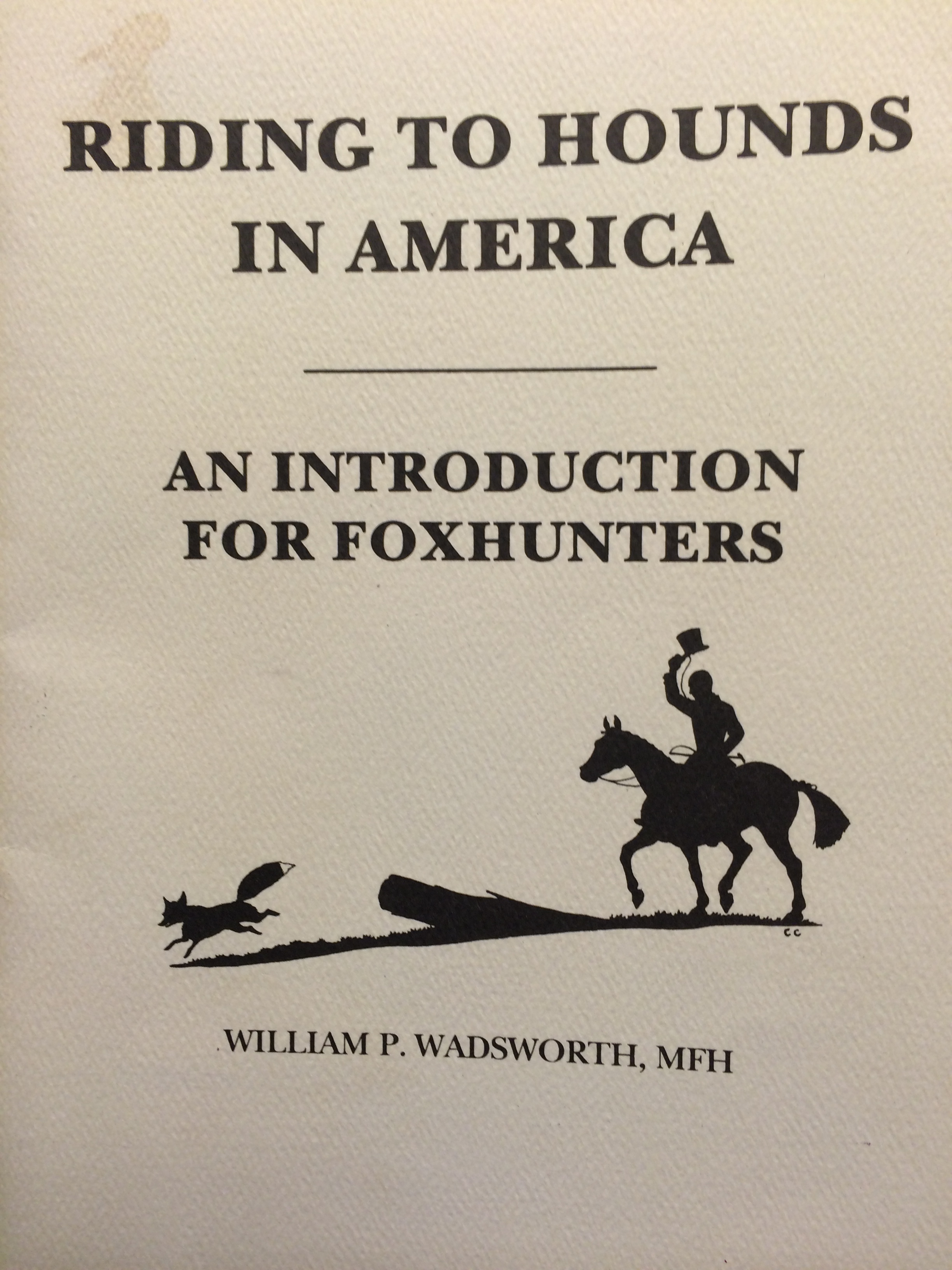
Two years later I went on my first authentic fox hunt in Newtown leaving from the kennels on Huntingtown Road, once again aboard Gingersnap. This thrill ride lasted hours, followed by a robust hunt breakfast and solidified my love of riding to hounds forever. As part of my continuing education about this sport, I was asked to read “Riding to Hounds in America: An Introduction For Foxhunters.” This slim curious pamphlet was originally published in 1962 by the Chronicle of the Horse magazine. The chapters first appeared as magazine columns written by William P. Wadsworth, MFH (that’s Master of Foxhounds). Chapters include Preliminary Matters, Hounds, Organization in the Field, The Fox, The Hunting Day, Hunting Etiquette, and Glossary of Foxhunting Terms.

photo

I poured over every single one of the 47 pages until I was sure I could behave properly in the hunt field. It is beautifully illustrated with those amusing drawings by Custer Cassidy, depicting everything from ‘Most beginners who hunt are ‘over-mounted’’ to the ‘working hound’ and his friend the ‘loafing hound.’ It pages are filled with advice from, greet the Master with good morning, never point your horse’s hind end at the hounds, and keep away from the hounds, at least 10 yards. I was so enchanted by the sport, I wrote a high school paper about it, the book and earning my colors with Fairfield as a junior member aboard my by TB gelding Speculation.

Donning my Fairfield County Hounds hunt colors with Speculation at Golden's Bridge Hounds Hunter Pace ~ 1993

Donning my Fairfield County Hounds hunt colors with Speculation at Golden’s Bridge Hounds Hunter Pace ~ 1993

Beyond the endless etiquette, it contains a bit of hound history. Wadsworth writes, “Hounds are hounds, not dogs.” He continues, “We know hounds  were bred for sport in the time of the Assyrians. We know that hounds were bred for stag hunting in the eighth century by the French nobility. We are fairly sure that these hounds were imported into England by the French after the conquest of 1066, and we believe that these stag hounds were the foundation stock of the hounds used to hunt stag and later fox. By the 17th century foxhunting had eclipsed stag hunting in England, and foxhounds have been bred as foxhounds ever since.”

Waiting for the hounds at a check during cubbing season

Waiting for the hounds at a check during cubbing season

Babble, Riot and Feathers 

All sports have jargon, and riding to hounds is no exception. We all know that the fox carries his “brush” when he leaves his “covert” and has “gone away.”  Listening to hounds “speak” while following the “line” of the fox as runs towards his “earth” is fun but sometimes the fox may “double back” to confuse the hounds whose “nose” has deceived them. But if a hound or a “couple” starts to “heel” they are making a backwards embarrassing mistake.

Hounds must not “dwell” or “babble” or “riot” since they have shown they are hunting nothing or something they shouldn’t be. And the worst insult to a hound’s sensibility is to draw a “blank” or to “check” because the hounds have lost the “line” hopefully only temporarily. A hound “marks” the “line” and will “open” the first time he “gives tongue” but once hounds reach a full “cry” you know that they are on the “line” until they start “feathering” for attention that the quarry has been found. And, did you know, a hound will actually “honor” when he “gives tongue” on a “line” that another hound has been hunting? See how easy it is to speak fox hunt? And one final piece of advice from Wadsworth, don’t ever jump a “panel” on a “lark” as it will annoy the landowners.

Jumping a panel coop on Hundred Acres Farm, Newtown, Connecticut aboard Speculation

Jumping a panel coop on Hundred Acres Farm, Newtown, Connecticut aboard Speculation

My First Canine Good Citizen Dog: Bruno the Norwegian Elkhound

In honor of AKC’s Canine Good Citizen program turning 25 years old, I unearthed my first CGC certificate in my canine archives. Good Job Bruno!

americankennelclub's avatarAKC Dog Lovers

By Lisa Peterson

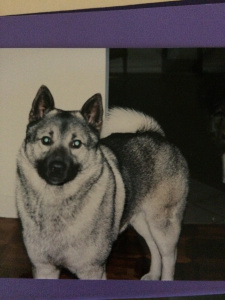
Bruno

Bruno and I were minding our own business on a walk around the hotel at the Norwegian Elkhound National Specialty in 1996 when a friend spotted us and said, “Hey, come take the Canine Good Citizen test, it’s right over here.” I had no idea what this was, in fact, I didn’t even know the 10-steps prior to signing up for the challenge. Bruno – an AKC Champion who had just turned 4 – and I had been training to start Novice obedience a few months earlier, so I though why not, he can sit and stay and heel.

We entered the ring ready to begin. I got nervous. Bruno took one look at me with his big brown cow eyes as if to say, “What’s the big deal? I can do this.” And off we went. The more steps we completed, the more fun Bruno…

View original post 252 more words

19th century foxhounds

The Roosevelts: Celebrated Dogs of America

While binge-watching Ken Burn’s historic PBS series The Roosevelts last week, a photo of Theodore Roosevelt and his hunting dogs triggered a thought; there is a meeting room in my office called the Roosevelt Room. I knew the collection of sporting dog prints and detailed pedigrees that graced the walls had something to do with “Teddy” but after a decade of sitting through countless meetings starring at these prints, their origins had been lost on me. So I took a recent lunch break to revisit the treasures of the Roosevelt Room at the American Kennel Club headquarters in Manhattan.

As you turn on the light switch, you are greeted by the black ink on grey paper cover art for the collection “Celebrated Dogs of America, Imported and Native, by A. Pope Jr., published by S.E. Cassino, Boston.” Beneath the poster a framed handwritten note card from Mrs. Richard Derby of Oyster Bay, New York, dated May 1974, reads, “These prints of Celebrated Dogs of America were collected by my father Theodore Roosevelt when he was a student at Harvard in 1879.”

Pointer dog breed

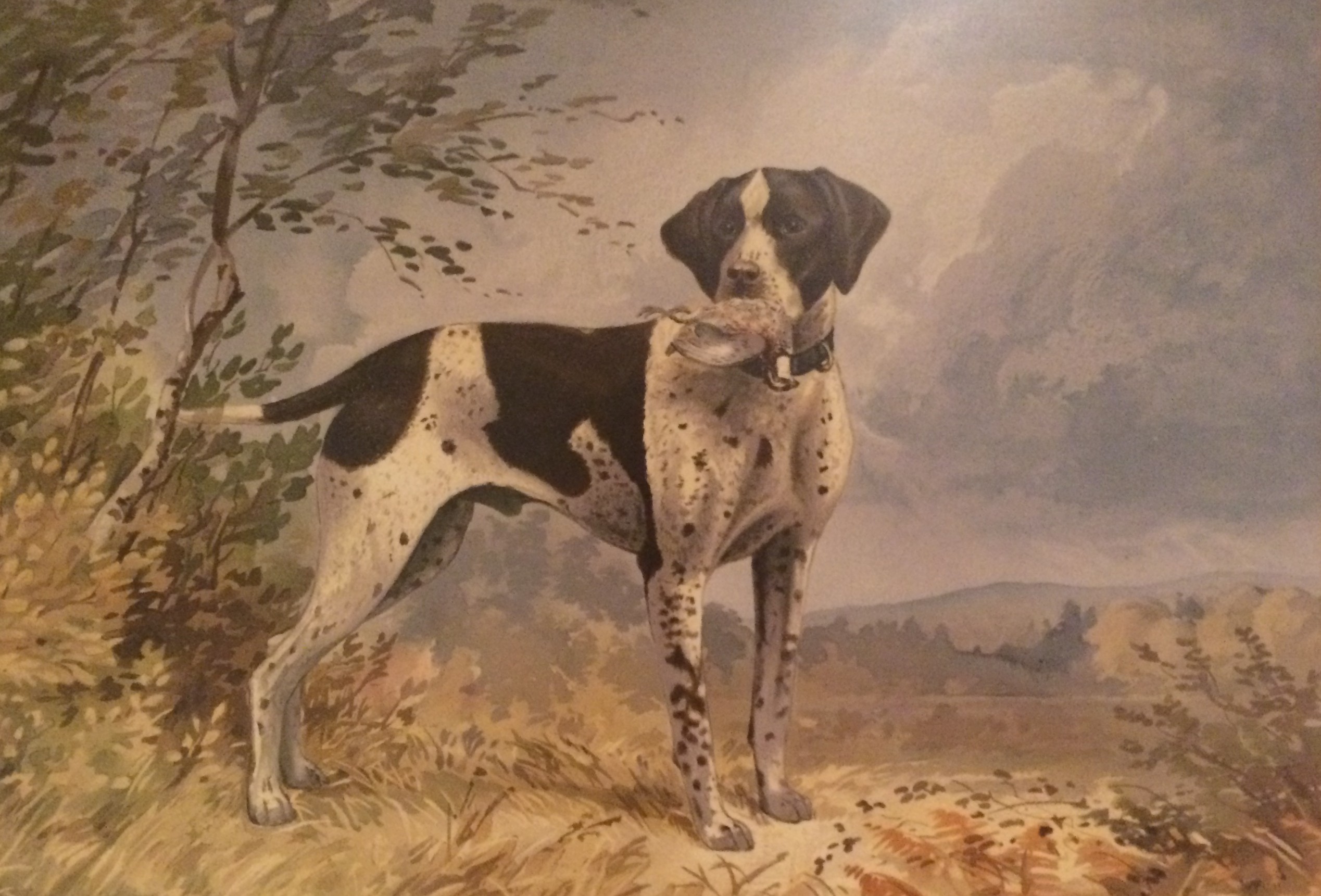
Dan the Pointer

As part of 19th century gentlemen’s society, Teddy must have not only studied, but hunted with these sporting purebred dogs. Today, the 18 muted chromolithographs of original watercolors painted by wildlife painter Alexander Pope, Jr. (1849-1924) hang in a neat row, midway up the walls, circling the room, except where their flow is interrupted by an HDTV used for video conferencing.

Celebrated Dogs of America

Who made the cut in 1879? Celebrants included a pack of black and white fox terriers named Rattler, Vixen, Tyrant, Minnie, Nettle and Daisy; the Rose Tree Fox Hunting Club of Philadelphia foxhounds, and several champion pointers including Dan, a native whelp born 1876 and owned by Mr. John G. Heckscher of New York City. Under Dan’s striking pose it reads, “Dan’s performance in the field have won him a high private reputation, and it is claimed by his friends that as a retriever he has no superior in this country. His first performance at a bench show was in Springfield in 1876, when he secured first in the puppy class, and the following year received ‘very highly commended’ at the New York bench show.”

Fox Terriers

Fox terriers Rattler, Vixen, Tyrant, Minnie, Nettle and Daisy

Trimbush, a Clumber Spaniel, whelped May 1875, had quite the pedigree. “Trimbush was bred by Mr. William Brailsford, head keeper to the Duke of Westminster, and was imported by Mr. Jonathan Tomas, jr., of New York. He is a perfect specimen of the breed and his superior could not be found in England at the time he was brought to this country.” Trimbush’s mother was Earl Spencer’s Sall, out of Earl Spencer’s Meg and Marquis of Exeter’s Beau, Beau’s sire being the Duke of Newcastle’s Rover.
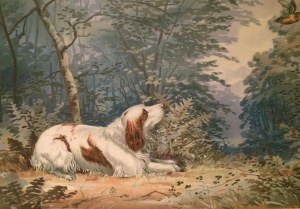
Clumber Spaniel

Trimbush the Clumber Spaniel

It seems that big fancy names were not the rage back then. Take for example others in the collection, champion Red Irish Setters Elcho & Rose, Don the smooth-coated St. Bernard, Mike, the imported Irish Water Spaniel, Lofty the Llewellyn Setter Dog, Jack, the English Mastiff, and the white Bull Terriers, Spider, Grabb and Nellie, whose likenesses silhouetted against farm fencing made a pretty picture.
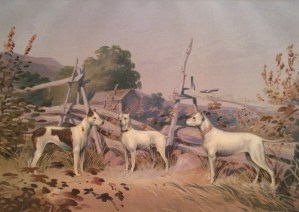
Bull Terriers

Bull Terriers ~ Spider, Grabb and Nellie

Historical Hounds in History

Some dogs had famous owners, like a pair of greyhounds named Tippecanoe and Prairie Girl. “Tippecanoe was a white dog formerly the property of General Custer and is a grandson of a great dog named Master McGrath.” Under the print a letter dated April 12, 1879, three years after Little Big Horn, from Mrs. Custer reads, “ Sir, I regret to say the pedigree of the imported hound General Custer received from Scotland has been mislaid among the papers in our home in Monroe, Mich. The pedigree of the dogs sent him from Canada we never had. I do not know whether the dog you own is from the Scotch or Canadian dog. We often had fifty in the pack of hunting hounds. I thank you for your kindness to the dog, and I am glad he has a good home. Very respectfully, Elizabeth M. Custer.”

greyhounds

Tippecanoe & Prairie Girl greyhounds

Rattler and Belle, two Beagles, owned by J.M. Dodge of Detroit came with this explanation. “Foot beagles should not much exceed nine inches in height; they are now even used up to eleven and twelve inches, going a pace which requires a good runner, in prime condition, to keep up with them.” Did Teddy ever had to keep up with these quick Beagles as they chased hares across the countryside.

Beagles

Rattler and Belle, two Beagles, owned by J.M. Dodge of Detroit

Bevis the Irish Wolf-Dog is my personal favorite. “Bevis is believed to be the only specimen of his breed in this country. He was bred in Ireland by a gentleman who has given a great deal of attention to bringing the breed back to its former excellence. (it being now nearly extinct). The dog was brought to America and shown at Westminster Kennel Club in 1879.” His description goes on to state “…The wild animals which he seemed powerful enough to conquer having long disappeared from the kingdom. The beauty of his appearance and the antiquity of his race are his only claims as he disdains the chase of stag, fox or hare.”

I wonder which dog was Teddy’s favorite? If you’d like to view the collection, drop me a line, it’s open for public viewing by appointment.
World Dog Show 2014

World Dog Show 2014

Dog shows are the best place to see a variety of breeds here in America. But seeing tens of thousands of purebreds gather from around the world requires a trip to the annual FCI World Dog Show (WDS). This year’s edition held in Helsinki, Finland, hosted by the Finnish Kennel Club (FKC) as part of their year-long 125th Anniversary celebration did not disappoint. Finland is a nation of dog lovers, avid hunters, and reindeer ranchers with 5.4 million citizens. According to the FKC, “Every fifth Finnish family owns a dog. Some 80% of these 600,000+ dogs are pure-bred. Each year, about 50,000 dogs representing more than 300 different breeds are registered in Finland.” Of those 300 breeds, only five are Finnish natives.

Finkies, Lappies & Reindeer Dogs

In honor of the FKC’s 125th, the show organizers waived the entry fee of Finnish Breeds. This brilliant public relations move created large entries of local dogs among the 21,200 dogs in attendance. An amazing 526 Finnish Lapphunds took up five of the 100 show rings one day. This friendly black and tan long-haired medium-sized dog has added to his hunting and herding roots to become a “Lapp dog.” Next up in the Finnish breed parade, an amazing 234 Lapponian Herders were entered. This breed is known for its reindeer herding ability in the northern reaches of Lappland. This breed is a smooth-coated black and tan version of the Lapphund. In fact, if you live in Finland and own property, each year the government will give you 2,000 reindeer to tend to. So you’d better have a Lapponian Herder or two kicking around to help with the herd. There were more than 100 Finnish Spitz – the national dog of Finland – with its brilliant orange dense coat, prick ears, curly tail and foxlike face.  Affectionately known as “Finkies” these “barking bird dogs” are known for their ability to flush upland game fowl for the adventurous hunter.

Another national favorite, the most popular registered native breed, the Finnish Hound, made a handsome appearance with his traditional foxhound looks of tan, black and white with long floppy ears to capture the scent of his prey of hare and fox. A Finnish Hound even competed in Best in Show. Wrapping up the natives was the majestic Karelian Bear Dog. This tall, mostly black with white accents hunter of bear, lynx and wolf, clearly demonstrated why he was classified in the Spitz and Primitive breeds group. I must have watched 75 male Karelian Bear Dogs. They are cool breed, similar to my own Norwegian Elkhounds in structure, Scandinavian spitz stature and hunting prowess, their temperament clearly remained on the primitive side.  While all dogs at American dog shows are expected to present themselves in a dignified and calm demeanor, these dogs loved to break out into snarling fighting spats in the ring. Now the handlers kept them all on a tight leash, but more than once as I sat ringside watching these magnificent creatures, I pulled my feet away from the ring as they passed, just in case!

Breeders’ Group and Best In Show

My favorite part of the World Dog Show was watching the Breeder’s groups. Each night the arena filled with teams of three to five dogs shown to represent a kennel’s bloodlines. Seeing the most consistent look from animal to animal to animal was a real thrill. Plus, they all dressed in the same costumes! From five Salukis handled by magenta bloused ladies, to four yellow dressed handlers with black Flat-Coated Retrievers in profile against them to smart burgundy suits walking with four Lhasa Apsos. Proud breeders showing off their best dogs. For more photos visit:  http://www.pinterest.com/elvemel/world-dog-show-2014-helsinki-finland/

There was much fanfare, a live band, and beautiful emcee, to finally announce that the  Affenpinscher “Tricky Ricky” (son of Joey, the Westminster Best in Show winner) won Best in Show.  But my top pick for the three-day event was meeting hundreds of native Finnish breeds. “Kittos” Finnish Kennel Club.