When one road closes…
…another one opens up.

When one road closes…
…another one opens up.




On a recent trip to Sagamore Hill in Oyster Bay, Long Island, New York, I went looking for a piece of my family history. In the process I discovered the depth of pet ownership of President Theodore Roosevelt at his family home.

Teddy Roosevelt’s family ~ Jack belonged to Kermit, fourth from the left in the front row, standing next to his seated mother Edith
The 26th first family had a plethora of pets, including notable dogs like Rollo the Saint Bernard, Sailor Boy the Chesapeake Bay Retriever, Pete, the bull terrier, his son Archie’s favorite pet, Skip the Rat Terrier, and most importantly, Blackjack or “Jack” the Manchester Terrier, the favorite dog of his son Kermit Roosevelt. All these called Sagamore Hill as well as the White House home.

The original ‘Jack’ the Manchester Terrier sits in a chair at Sagamore Hill, circa 1904
While at Sagamore Hill to retrace my grandfather’s brush with history, I imagined the six Roosevelt children running around the 3-acre garden with ponies and puppies.
As a chauffeur for a Rockefeller in-law in 1925, my grandfather happened to be driving alone along Cove Neck Road in a rain storm and came upon a well-dressed woman scurrying home. He offered her a ride and drove the former first lady to the front door of Sagamore Hill. As I walked the route of my grandfather’s good deed, I took in the landscape of the 155-acre working farm and discovered the family’s pet cemetery near the stately home.
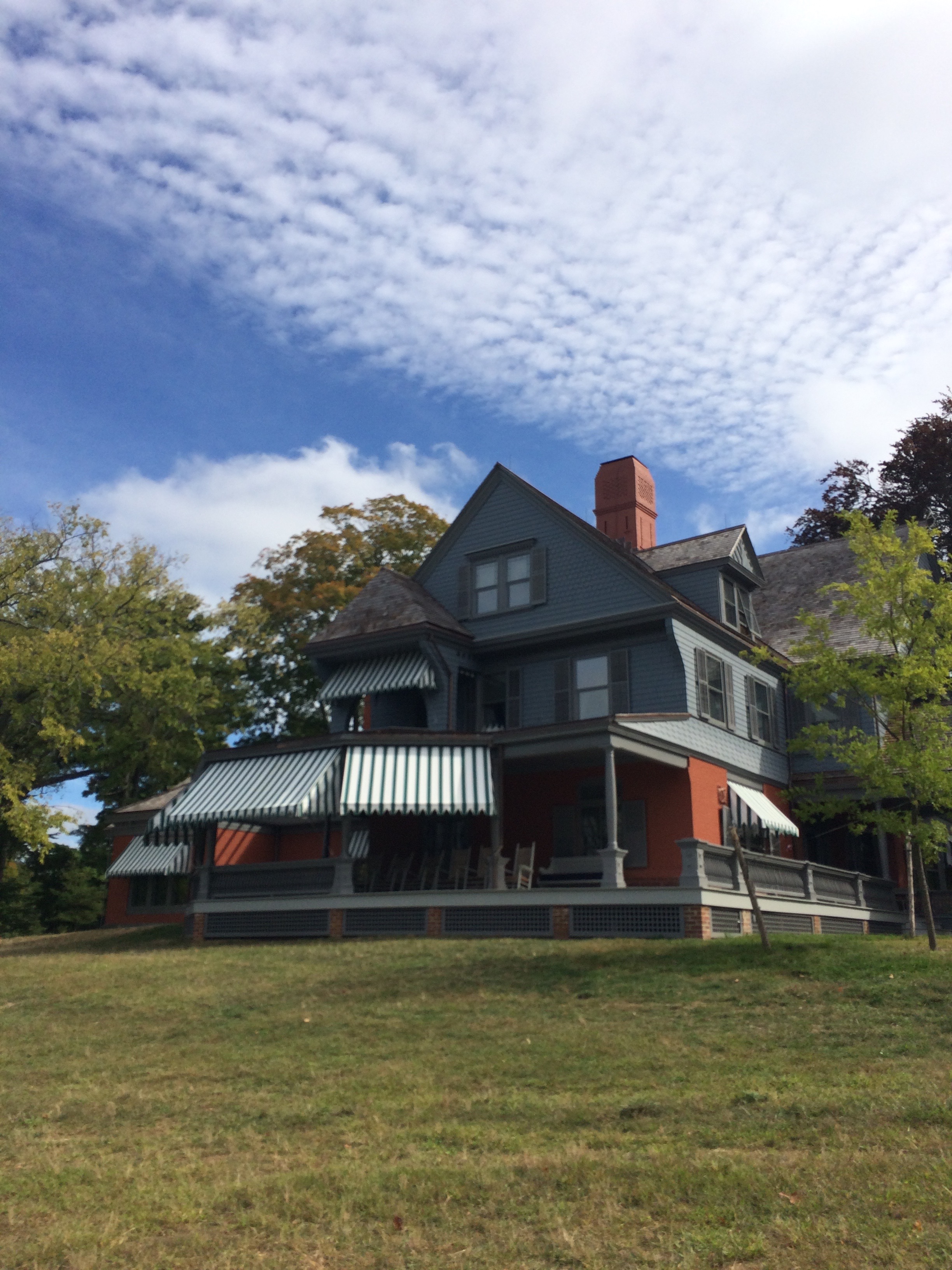
Sagamore Hill, Oyster Bay, Long Island, New York
The Roosevelt’s menagerie, some would say zoo, occupied the home from 1885 through the children’s grown up years, past 1919, the year of the President’s death at age 60 and until Edith Roosevelt’s death in 1948. The stable and lodge that housed the horses was built around 1884 before the farm when into production. Horses were used to pull plows around the estate and carriage horses, like General and Judge, took them through the villages of Long Island around the turn of the 20th Century. Roosevelt was known for his jumping and polo playing skills and Bleisten was his favorite horse. Shetland ponies, like the famous pinto named Algonquin, taught the children to ride.
Beyond the family pets, the children treated many of the farm animals as their pets too. The cows, horses, and chickens joined the dogs, cats, guineas pigs, rabbits, a badger, kangaroo rats, snakes, bear cub, lizard and others. You can see the full list at presidentpetsmuseum.com
Jack The Manchester Terrier
Several letters date 1902 from Roosevelt’s years in the White House, reveal the depth of the family’s affection for animals. Teddy writes to a Mrs. Field of Chicago that he had, “such pleasure to send you a photo of my boy Kermit with Jack, the Manchester Terrier, who is absolutely a member of the family.” Later in the year, President Roosevelt is complaining to another family friend that he could not possibly take another Collie puppy as a gift to the household because, “we already have three collies, one of them a puppy, and four other dogs in addition, and that I really have not house space or stable room for any more.”
They valued pets as family members and each got a formal funeral ceremony and burial. Kermit’s pet Jack was most beloved by the whole family. So much so that he was buried twice. First at the White house, where he was the nation’s first pet. He was laid to rest under one of the rose bushes in the famed garden. But then Mrs. Roosevelt, the same fine lady my grandfather “drove” insisted that he come home to be buried at Sagamore Hill. After Roosevelt was no longer President, she could not bear the thought of Jack being so far away under the gaze of politicians who cared nothing for the beloved black breed and her Jack in particular.
On an exhibit at Sagamore Hill Teddy is quoted in his autobiography as saying, “As for the dogs, of course there were many, and during their lives they were intimate and valued family friends, and their deaths were household tragedies.” Photos of Jack adorn the exhibit, but so does the actual stone monument that marks his grave in the pet cemetery. It reads, “Faithful Friends, 1902, Susan and Jessie, Little Boz. 1903 Jack.
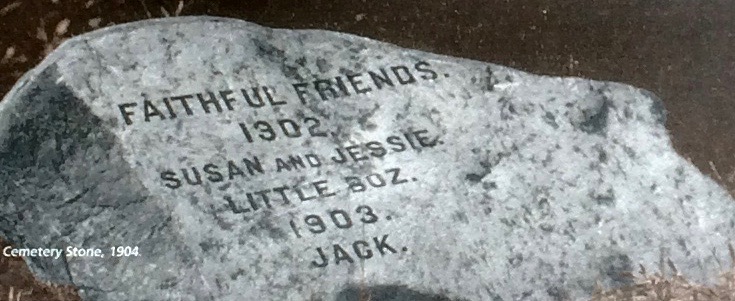
Jack’s gravestone as it appeared more than a century ago

Jack’s grave as it appears today at Sagamore Hill
Today, Sagamore Hill is open to dogs to walk the remaining 83 acres of Teddy’s pet paradise. Of course, now visitors must abide by the National Parks Service regulations which are noted in Section 2.15 of the Code of Federal Regulations that states that pets must be “restrained on a leash which shall not exceed six feet in length, or otherwise physically confine a pet at all times.” So, while still pet friendly, it’s not quite the same as a century before when animals roamed free across the summer white house lawn.

Horses and parades go together like peanut butter and jelly! This partnership began millennia ago when horses were paraded around to celebrate battle victories. More recently, the Horse Guard Parade, those beautiful black horses of the British monarchy stabled at the Royal Mews in London, codified the daily practice of ceremonial parades in 1745. There is even a type of horse in America called the Parade Horse. This breed is used in a sport the celebrates the Southwestern tradition where stylishly dressed ranch owners would ride into town on their high-stepping horses in saddles dripping with silver.
Today, I rode in my first parade, a mounted costume parade through the streets of downtown Danbury. Hosted by Happy Trails Farm, nearly 20 horses — and one donkey — ridden by a costumed clown, giraffe, queen of hearts, cowboy, ghost, Game of Throne’s winter, and even a pair of horseflies, paid homage to Halloween and horses. Dressed as Downtown Abbey’s Lady Mary out for a hunt my trusty steed Oz and I proudly marched across busy city intersections and bustling suburban woodlands with ease. He was such a good boy! And it was his first parade too.

Oz waits to head off on his first parade!
But, the best part of the day was watching the spectators stare in awe at the horses. People came out of their apartments to wave. Others stopped their SUVs to watch the horses stroll down the cityscape. Dogs hung their heads out of car windows to get a glimpse, or bark a greeting. Many residents came to the curb to take photos of horses in their ‘hood. One man shouted, “You made my day!”
American Pharoah’s Post Parade
His remark reminded me how rare it is today to see a horse on any given day. On Halloween this year most people who saw horses, saw them in a different kind of parade, the iconic ‘post parade’ of Thoroughbred racing.The ‘post’ is the starting point of the race. It’s name comes from the early days of racing when only a post at the rail marked the beginning of the race. It’s why today, horses have ‘post’ positions, not starting gate positions. Before each race, the horses are called to the ‘post’ by a bugler playing some form of First Call. Once played, jockeys mount up, leave the paddock area and ‘parade to the post’ in front of the grandstand. It’s this pre-race parading that gives fans and bettors a good look at their favorite horses.

American Pharoah in the Post Parade at Saratoga Race Course
After his post parade, millions of TV viewers watched Triple Crown Champion American Pharaoh make history with his Breeder’s Cup Classic win at Keenland Race Course in Kentucky. A new achievement in America’s oldest sport was born, the racing grand slam — winning the Kentucky Derby, the Preakness, the Belmont Stakes, and the Classic. As a huge AP fan, I cheered him on as he pulled away at 6 and half lengths. Announcer Larry Collum screamed, “He’s a horse of a lifetime!” as he crossed the finish line in a track record of two minutes. Jockey Victor Espinoza turned and smiled for the finish line camera to mark the end of AP’s triumphant racing career.
For most viewers of this historic achievement, sadly, television or social media will be as close as they ever get to see, not only a horse of a lifetime, but a horse in their lifetime. American Pharoah reignited the sport of horse racing and I’m hoping that with it the preservation of the horse, all horses, has truly begun. No longer are horses the mainstay of transportation. No longer do they pull plows for farmers to create food. No longer do small stables offering riding lessons or backyard barns to keep a pony for the children dot the landscape. There just aren’t as many opportunities for people and horses to cross paths and connect in the modern world. In cities we may occasionally see carriage horses, mounted police officers, or those in parades! In the suburbs, apart from secluded private farms, horses are even harder to spot in daily life.
I don’t want the horse to disappear from the landscape. We need horses in our lives. If you have never been in the company of a horse, go find one today, bring them a carrot, and say hello. They will change your life. They are magnificent animals with a deep, historic bond with humans. Oz and I may have done our post parade while following a black horse ridden by a bumble bee, but we were happy to share the beauty of horses with others. AP’s trainer Bob Baffert said it best about his charge — and all horses — when he called him, “a gift from God.” Let’s cherish them all.

The most recent Metropolitan Transit Authority (MTA) police graduates came heeling into Grand Central Terminal’s Vanderbilt Hall October 21st amid the Pomp And Circumstance Walking Commencement March and the MTA Pipe & Drum Band Ceremonial Unit presenting of the colors.

MTA Pipe & Drum Band Ceremonial Unit presents the colors at the MTA Police Canine Explosive Detection Graduation
After bagpipe music filled the cavernous terminal, everyone fell silent when the Phantom of the Opera’s Marcus Lovett sang the National Anthem. A moment of national pride.
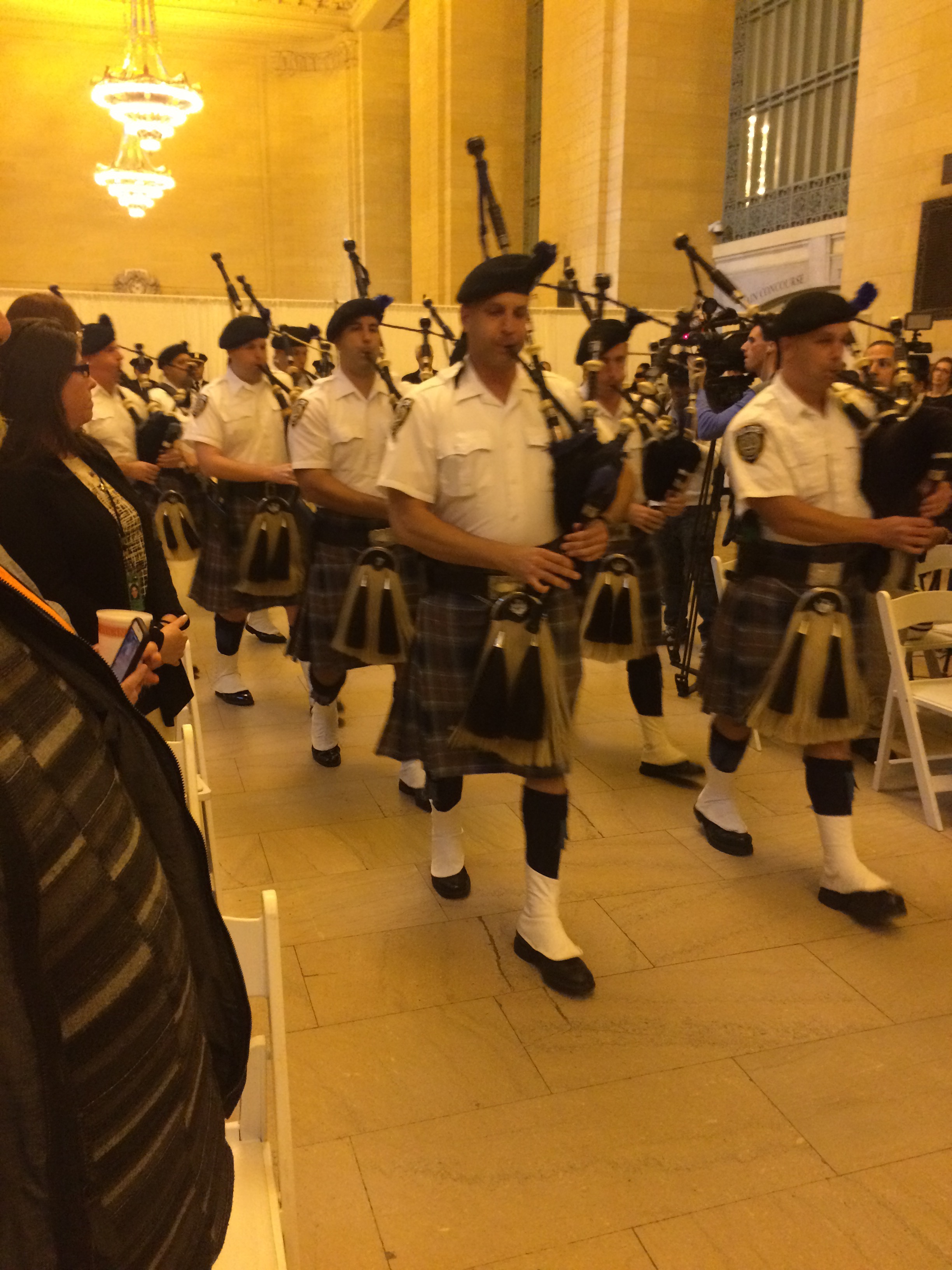
Only thing better than hearing bagpipes in Grand Central Terminal is Marcus Lovett singing the National Anthem
This ceremony was like none other.
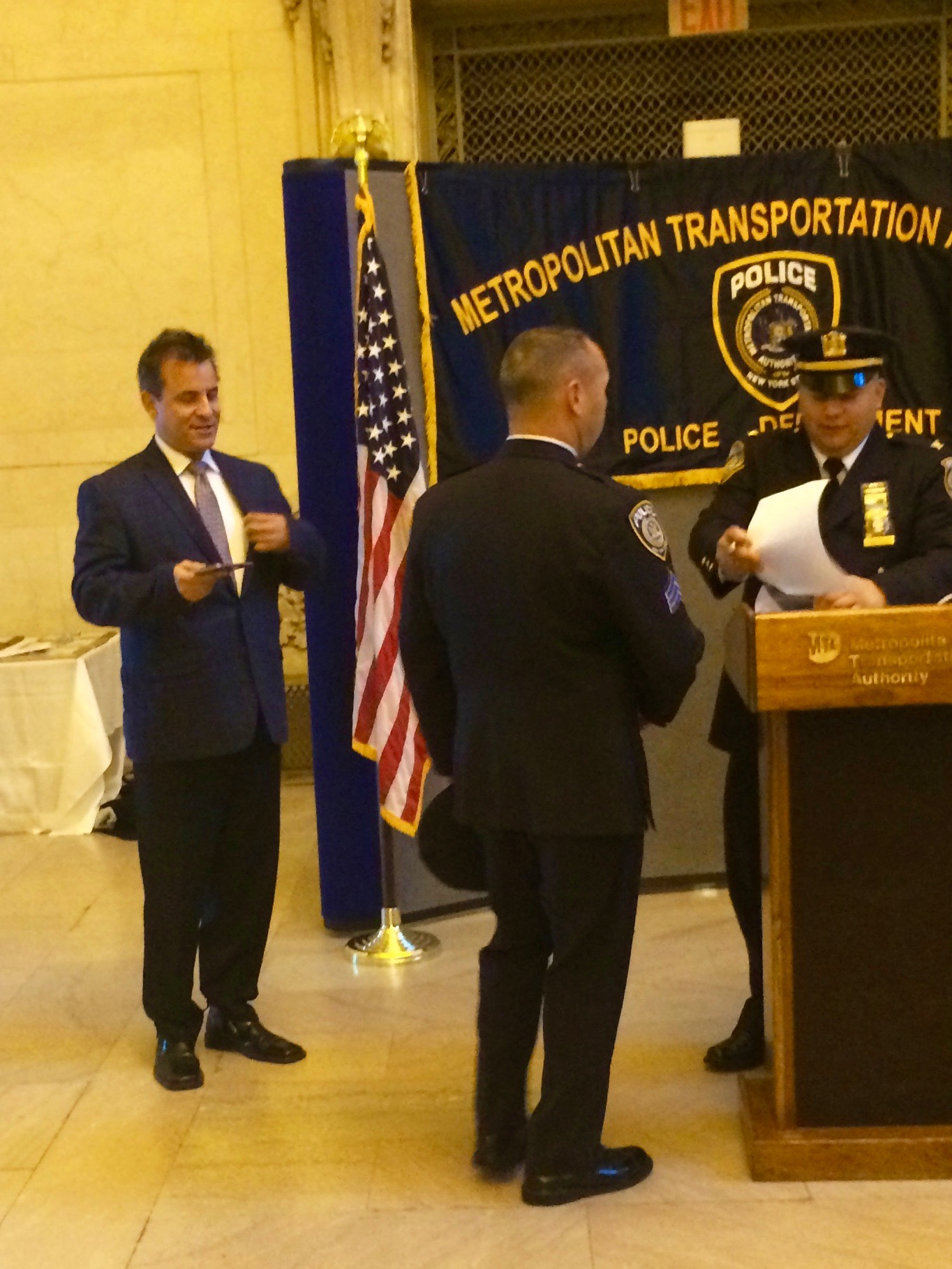
Marcus Lovett, left, during rehearsal. He sang the National Anthem after the presenting of colors and America The Beautiful during the recessional
Among the 19 law enforcement canine graduates, there were 15 MTA police dogs and two from the Putnam County Sheriff’s Office. There were German Shepherds, Belgian Malinois, several that were a mix of those two breeds, and two adorable yellow labs, hailing from the United States Park Police. The proud canine handlers and their partners walked forward, one-by-one, executed a sit, and received their new badges dangling from a collar hung around their necks.
Graduates received either the 12-week explosive detection training and / or the 16-week anti-terrorism training at the MTA’s 72-acre training facility in Stormville, NY. During the ceremony the canine unit’s executive officer Lt. John Kerwick, explained how these dogs are a valuable tool with, “four legs, a brain, keen instincts, good eyesight and a nose that is 3000 times stronger than humans. They can interrupt a threat to keep MTA customers and employees safe.” One dog can scan an unattended package in minutes versus calling in the bomb squad. The MTA Police Canine Unit, founded in 2002, is one of the largest explosives detection units in the country. They have approximately 50 dogs, which last year responded to 25,860 requests for service and inspected and cleared 2,584 unattended packages.

Each handler received a diploma, each canine received a badge, and each family of the dog’s namesake received a plaque. Then all posed for a group photo to commemorate graduation
Connecticut MTA Police Canines
And while these police canines are first responders to a dangerous threat, they also carry a tribute each time their handler calls their name. Each of them is named for a fallen hero or dedicated officer. As each graduate received his badge, the family members of the canine’s namesake were invited to come to the podium to share a moment of sacrifice and service that the dog’s name will carry on. Each family received a commemorative plaque with the dog’s photo, name and a description of the officer’s sacrifice and service. Three of the graduates live in Connecticut and these are their stories.
K-9 George and MTA Police Officer Allan Fong from Fairfield. George was named in honor of Police Officer George Wong of the NYPD, who died on May 24, 2011, from illnesses he contracted after inhaling toxic materials as he participated in the rescue and recovery efforts at the World Trade Center site following the terrorist attacks on September 11, 2001. Fong said he wanted to name his dog after Wong, who helped him as a young NYPD officer. He and George have been through months of training in tracking, article recovery, subject searching, wide field search, and handler protection. The 91-pound German Shepherd/Malinois mixed-breed is Fong’s first police dog.
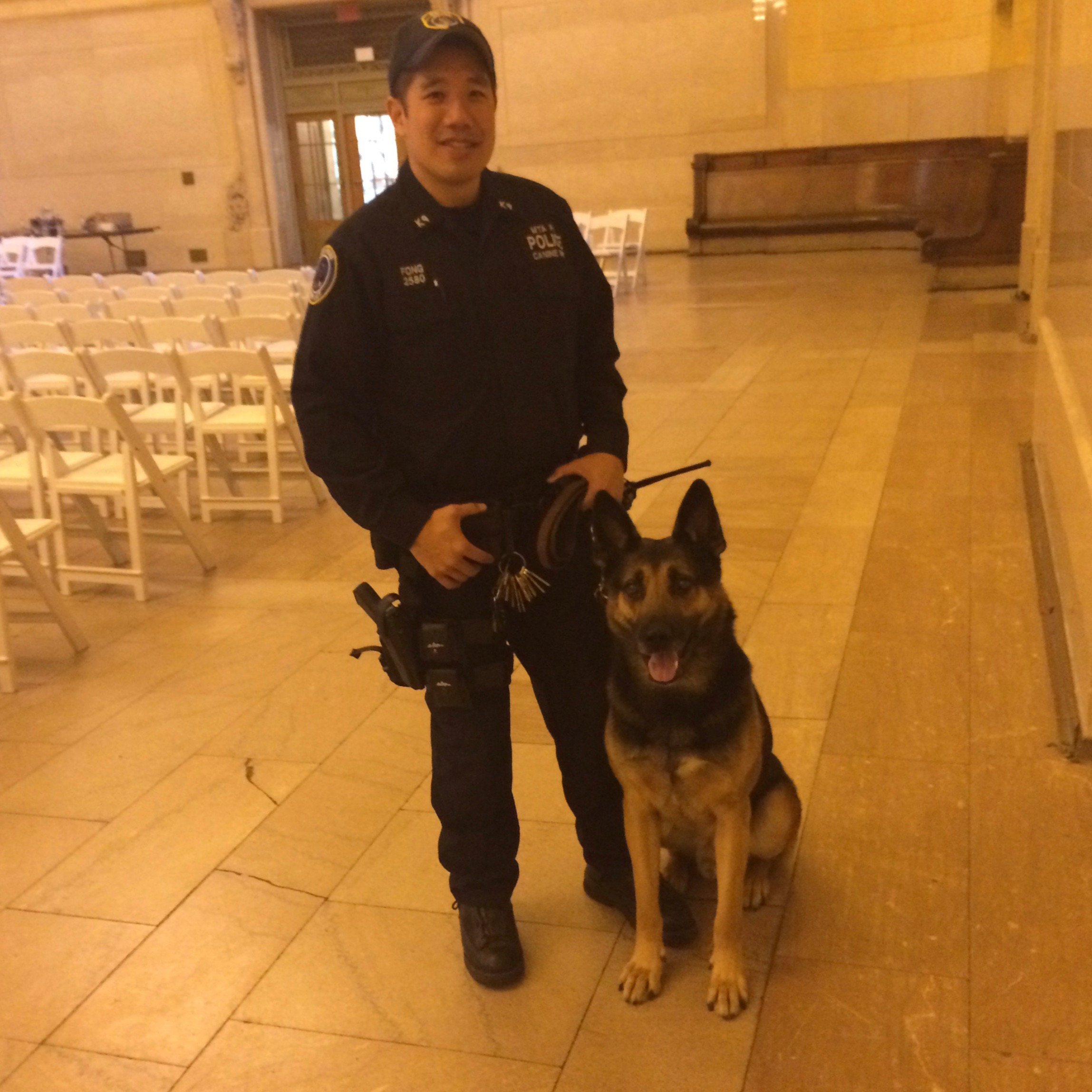
K-9 George and MTA Police Officer Allan Fong after graduation
“He has a very good temperament, is great at home, loves coming to work, loves being in the back of the truck,” Fong said. “He can’t get enough of coming to work!” And while his main purpose is to patrol MTA properties, he also assists other agencies in need of assistance, such as tracking down lost children. Each dog and handler develop a deep bond working so many hours together. “I’m with him like almost 24/7,” Fong said. “I spend more time with George than I do with my wife or kids.”
K-9 Johnny and MTA Police Officer Kevin Pimpinelli of Naugatuck. Johnny is named in honor of Sergeant John Mullen of the MTA Police Department, who suffered a fatal heart attack while on duty on January 26, 2007. Mullen was Pimpinelli’s supervisor for many years. In fact, Pimpinelli’s first dog, Mullen was also named for the late MTA sergeant. There were 12 Mullen family members in attendance at Johnny’s graduation.

K-9 Johnny as he appears on his own trading card. Each of the MTA Police Canines have cards that handlers can share with children. On the back of the card Johnny says, “If you see something, say something.”
K-9 Johnny had a blast at the graduation. “He’s a social dog, loves people petting him, little kids walk right up to him and even loves getting a belly rub,” Pimpinelli said. The two-year-old purebred German Shepherd was born in the Netherlands. He is fully trained for explosives detection and certified in NY and CT. K-9 Johnny can detect about 15 different explosive odors. “Once he finds one, he’ll sit and stare right at that item. Then I have to interpret what he is doing.” Pimpinelli explained. It’s this communication between dog and handler that creates a great team.
Pimpinelli said that his first dog Mullen is retired and lives as his home. He joked that Johnny and Mullen both vie for his attention. “They both sleep in the bedroom, one is on one side of the bed and one is on the other side of the bed. Sometimes, they both try to be on just one side.”
K-9 Vinny and MTA Sgt. William Finucane of Guildford. Vinny is named in honor of Sgt. Vincent J. Oliva of the Port Authority Police Department, who died on November 27, 2013, after a battle with cancer. Sergeant Oliva led the Port Authority Police Department’s Canine Unit. Today, Sgt. Finucane, is the head trainer for the MTA police canine unit. It was him and three assistant trainers — police officers John Brazil, Nelson Hernandez, and Allen Kirsch — that trained the 2015 graduating class.

Sgt. William Finucane asked K-9 Vinny to sit to receive his new badge at the MTA Police Canine graduation at Grand Central Terminal
K-9 Vinny, is Finucane’s fifth dog, and came to him serendipitously. “He wasn’t a planned dog. Vinny was going to replace another dog that was having problems, but he made it. So now I have a dog with no handler,” Finucane recalled. His dog was 12 years old and ready to retire, so Vinny became his.
Thanks to Lt. John Kerwick for inviting me to this very special occasion!

Lt. John Kerwick, his recent graduate K-9 Seabee, a German Shepherd, and me.
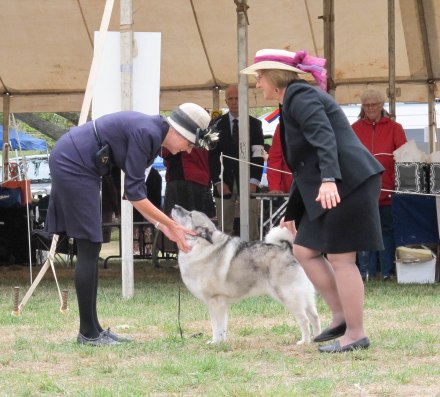
Every five years all of us in the dog fancy don fashionable hats and period outfits to celebrate a commemorative version of an iconic dog show. Since its reincarnation in 2000 by a group of dedicated fanciers, the Morris and Essex Kennel Club dog show has become a modern classic with a serious nod to its traditional roots.

Donning my fashionable M&E hat and outfit in the grooming area.
M&E sprouted in 1927 when Mrs. Geraldine Rockefeller Dodge, niece to the oil baron, sprayed large white tents across her polo field to host thousands of show dogs. The scene at her “Giralda Farms” estate became the annual setting of her signature kennel club in Madison, New Jersey. She personally financed the show for decades. It became a valuable place to come study the best dogs while appearing on the social scene. Mrs. Dodge made it special by offering sterling silver trophies, lavish flower decorations, catered meals for VIPs and the famed boxed lunch for all exhibitors. Only the war years silenced the great show which ended its run in 1957.
If you want to know more about the original M&E, a new book, The Golden Age of Dog Shows: Morris & Essex Kennel Club, 1927-1957, with a forward by William Secord, famed canine fine art historian and gallery owner, promises not to disappoint dog show historians.
Morris & Essex Kennel Club 2015
Last week M&E’s 2015 edition did not disappoint. A record-breaking 4,666 show dogs made it the largest, outdoor one-day dog show in American History, something Mrs. Dodge would have been proud of. For the previous two shows, in 2005 and 2010, my employment dictated I remain a spectator. But this year, unencumbered, I became an exhibitor for the first time. My kennel of three Norwegian Elkhounds would be among the thousands.

Showing Adele in the 12-18 month puppy sweepstakes class. She went on to win the 12-18 months regular class. Her litter sister Marnie (seen at the end of the line) took Winners Bitch for a 5-point major as part of the GSNEC specialty held at M&E.
Because this is a special show, I decided it would be a fitting tribute, rather a retirement of sorts, to bring my 12-year-old veteran bitch Jinx, officially known as Ch. Elvemel For Your Eyes Only, CGC, to her final show. Her show career ended a decade earlier due to my AKC employment restrictions. The day she earned her championship I was barred from showing her. I remember how I cried winning that major at Bucks County Kennel Club on a blustery May morning in 2005.

Jinx becomes a Ch. Elvemel For Your Eyes Only at Bucks County KC dog show in 2005.
She is the culmination of 20 years of careful breeding, one of the best bitches I’d ever produced. She’s showy with no off switch, a handler’s dream. A direct line back to my foundation bitch, I never got to show her as a special. As an owner/breeder/handler, giving up showing and breeding my dogs to work at AKC to promote showing and breeding dogs was a bittersweet burden.
It’s Show Time!
My dogs know when its time to go to a show. The cues are everywhere: baths, grooming, packing the van and cooking the liver. The morning of, they see us scurrying around the house gathering last minute items, leashes in hand. They are smart, they have memories of fun and excitement. Jinx was especially animated last Thursday. I could hear her brain, “Dog Show! Dog Show!” She knew, after all those years, where she was going. We left at 4 am since we heard the lines to get to the rings might be long. We arrived at 6 am and unloaded ringside in the dark, under one of those large white tents, now sprayed across Colonial Park in Somerset, NJ.
After walking the dogs around the well-appointed grounds, past trophy displays, floral arrangements, and fashionably dressed folks, I gingerly placed Jinx on the grooming table. Bark! Bark! Bark! Bark! Jinx announced. Some things never change. After primping the old bitch, show lead on her, we headed to the ring. As the steward called our number, we proudly walked in. Our heads held high, her’s looking for treats, mine trying to keep my fancy hat on my head in a blowing wind.

Jinx at age 12, shows like a charm at M&E in the Veteran Sweepstakes under Judge Sue Ratz. Her son, Ch. Elvemel Casino Royale CGC, captured Veteran Sweeps Best of Opposite, making us very proud!
It’s customary at shows, when veterans (dogs over 7 years old) are gaited around the ring, to give them a round of applause. Most veterans are returning ‘show veterans’ with long careers. For Jinx, she was here because she belonged here as the fruits of my labor as a breeder. She was here so others could study dogs, could study her. As the judge went over her aging body, she sparkled. Those beautiful dark brown eyes still captured hearts. As we gaited around the ring for that final time, applause as Jinx pulled the lead between us taught, I felt those tears well up again. This time, it was pride, not sadness. The owner of her sire was watching ringside. She commented how watching Jinx was like watching Jag move gracefully around the ring. As a stud dog, he had stamped his quality on her. As a breeder, I had recognized that and matched it well with Jinx’s dam. It was good to know that after decades of studying dogs, as a breeder, I finally got it right in a beautiful bitch who disappeared for a decade from dog shows.

From city livery stables to carriage houses on large estates, my great-grandfather was known to drive a four-in-hand team with skill. A career coachman, he came upon his vocation at the turn of the 20th century, when carriage popularity was waning.

My great-grandfather Oscar Nelson drives a well-matched pair on Cortland Street, Sleepy Hollow, New York circa 1910
Last year, a carriage horse and driver took me on a wonderful tour of New York City’s Central Park, which ignited a desire to learn more. And while I may carry coachman’s DNA, I have never taken over the reins from a driver until last week when a friend offered to take me for a drive around my neighborhood with one of her horses pulling a light, two-wheeled ‘buggy.’

Tyler and his carriage at New York City’s Central Park
Carriages by Brewster & Co.
Carriage making was a major 19th century industry. The Brewster family had vast showrooms filled with Landaus, Broughams and Lady’s Phaetons, with factories in New York City and New Haven dating back to 1810. Brewster & Co. produced beautiful hand-built carriages, even earning a gold medal at the Paris Exposition in 1878. Business boomed for decades as they became known as the “Carriage Builder for the American Gentleman.” Among their customers were Rockefellers, Vanderbilts, Astors and J.P. Morgan, each with their own colored coaches, not to be owned by anyone else. But steam-powered train transportation exploded between the1830s and 1860s and signaled the beginning of the end for the horse-drawn carriages. The end came with a new invention called the “horseless carriage” during the Gilded Age.

Brewster Carriages, built in the 19th Century, were the finest in the world
By 1896, the first electric car was built by Brewster & Co, and by 1905 the company had ceased making horse-drawn carriages in favor of automobile bodies. But even then, the custom-made “coaches” couldn’t compete with mass-produced automobiles and in 1925 Brewster & Co. was sold to Rolls Royce of America.
William Brewster, Brewster & Co.s final president had a daughter named Barbara Brewster Taylor who lived in Southport, CT. Each year she would graciously open her estate – surrounded by natural jumping obstacles simulating a fox hunt – to host the Fairfield County Hounds annual hunter trials up until the late 1970s. I remember the gracious white-haired lady would come to watch occasionally. All I knew at the time as a teenager was that her father made “world-famous carriages and buggy whips.”

An 1887 Park Drag Brewster Carriage pulled by a team of fine carriage horses, possibly Cleveland Bays
Royal Coaches
Despite progress, you can still find the world’s largest collection of working coaches and carriages at London’s Royal Mews at Buckingham Palace. Among them are the gilded, golden Coronation Carriage built for Catherine II and the sleek, black Glass Coach, my favorite when I visited the Mews, which carried Lady Diana Spencer to Westminster Abbey on her wedding day in 1981. Another popular open carriage, drawn by six of the Queen’s horses, is the 1902 State Landau which carried Kate and William, Duke and Duchess of Cambridge, back to Buckingham Palace after their wedding in 2011.

The Glass Coach returns from Opening of Parliament
Driving Versus Riding Horses
Sitting in the two-wheeled buggy I felt like royalty as we headed down the road. “Clip-clop, clip-clop, clip-clop,” sounded the hooves striking pavement. Feeling the motion of a small carriage is very different than horseback riding. A rhythmic bounce that can be softened by bracing your feet against the carriage floor and pushing your back into the seat. Before my friend turned over the reins, we had a safety lesson. “Always wear your seatbelt,” she told me. A little loop at the end of the reins placed over your pinkie finger. “The last thing you want to do is lose your reins while driving a carriage!” “Don’t stick your hands near the moving wheels or you will break your arm.” All valid points.

Walk on! My first drive!
Carriage horses are trained by voice to “walk on,” “trot,” “walk,” “whoa,” “stand,” and my favorite, “come around.” This last maneuver moves a carriage on a turn, the horse executing a side-step, leg over leg turn on the haunches to turn a carriage left or right. Unlike riding where you have your seat and your legs, you only have a few aids left to control your horse: your hands, your voice and the fabled buggy whip.
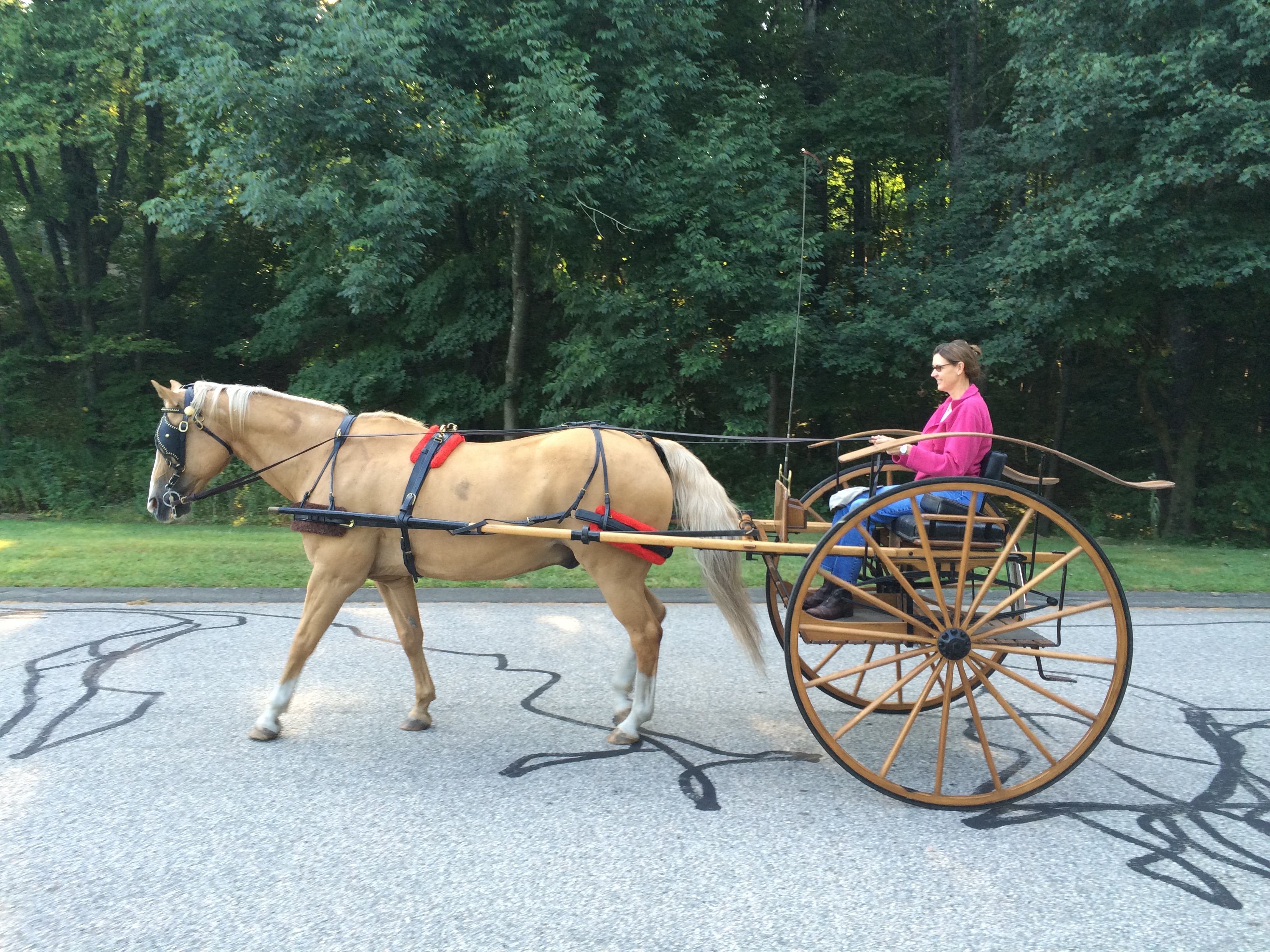
Heading down the road
Easily I got the hang of using my hands. The long reins held between the pointer and index fingers to drive a horse versus between the thumb and index finger while riding. The mechanics of steering, turning and stopping were executed with a stronger bit. And, just like riding, when you are on the road, and a big, loud, scary yellow school bus comes barreling down the road behind you, focusing your horse’s attention on anything but the school bus is paramount. You focus on the gait, “Walk on.” You point the horse’s head away from the impending confrontation. You hold your breath! And when the bus followed by eight cars passes, you tell the horse, “Good Boy!”

Good Boy Butter!
Despite the slow speed of a horse-drawn carriage compared to today’s cars, they can be dangerous places as horses can be unpredictable, and occasionally, will bolt despite being harnessed to a large wooden structure. “Always have an exit strategy,” was part of the safety lesson. If you don’t, you can get seriously injured, as evidenced by many carriage accidents with runaway horses recounted in The Bee’s ‘Way We Where’ from 100 years ago. This time, however, I got a delicious taste of a bygone era, when horses pulled carriages and people needed them to explore and discover their world, at a much slower pace. The sky, the fields, the trees, the flowers, the birds, all came into view on their own, just waiting for my discovery.

Heading back to the barn
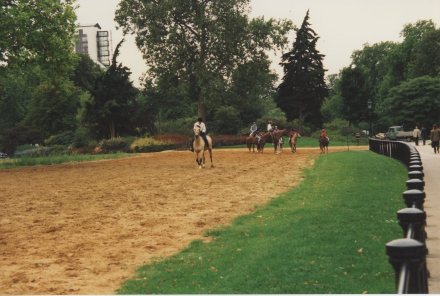
There’s nothing quite like urban horseback riding. Today equestrians can ride where kings once ruled and the city’s elite came out in livery carriages ‘to see and be seen’ along an historic path called Rotten Row in London’s Hyde Park. A plaque in the park tells us its story: Rotten Row The King’s Old Road Completed 1690 – This ride originally formed part of King William III’s carriage drive from Whitehall to Kensington Palace. It’s construction was supervised by the Surveyor of their majesties road, Captain Michael Studholme, and it was the first lamp-lit road in the kingdom. Designated as a public bridleway in the 1730’s, Rotten Row is one of the most famous urban riding grounds in the world.
Rotten Row Rituals
Hyde Park Stables, on a quaint side street called Bathhurst Mews her the park, offers horse rentals. During one trip to London I mounted up. As we exited the lane, the sound of iron horseshoes landing on ancient cobblestones gave rhythm to our walk towards the park. Our group of eight waited briefly beneath the Archery Tavern pub sign before crossing heavy traffic on Bayswater Road to enter the park beneath Victoria Gate.

Waiting by London’s Archery Tavern on our way to Hyde Park
Sitting tall in the saddle, feeling the horse’s stride lengthen, we both relaxed with each stride as we walked along the West Carriage Drive. As we crossed a bridge over The Serpentine, the park’s biggest lake, we gathered up behind the Albert Memorial. Surrounded by greenery, tall trees and bushes brilliant in their fall colors, we stepped upon the famed Rotten Row.
“We are all going to wait, until I tell you to go, and take a canter, one at a time,” our instructor said. POW! A small bay pony burst forth down Rotten Row with a little boy astride. He was kicking his little legs, that barely reached below the saddle, and flapping his little arms like a bird trying to take off. Elbows pointed skyward came slamming against his sides in unison with his legs hitting the pony’s barrel side.
“Stooooop Him!… Stop Him!…” came the call from our leader. Little boy must have been deaf as the more he was yelled after, the faster his fluttering legs and arms moved. Now, the leader took off after him, making a daring grab of the reins to pull the pony to a stop. Many in our group were having a good chuckle. Then once all back in formation, one at a time — pony and boy sent to the end of the line — we did our own impressions of fluttering legs and arms to get our bridle-path weary horses to canter down Rotten Row.

Leaving the group to canter down Rotten Row on Sedrick, a handsome buckskin from Hyde Park Stables
Most were obliging, others needed more coaxing. The mile long canter down a 75-foot wide path of fluffy tan footing made for a nice ride. Compared to the hard packed cinders on Central Park’s bridle path, it was like floating on a cloud. The challenges in any park setting, waiting for something to dart out into your path that might spoke the old steed, were ever present. The scenarios were endless. Dogs, children, children chasing dogs, balls, children chasing balls, dogs chasing balls, children chasing dogs chasing balls, errant tourists, police on horseback in pursuit of suspects. You get the picture. After safely making it down Rotten Row to Queen Elizabeth’s Gate at Hyde Park Corner, we stopped to collect our breaths and release a sigh of relief. What a lovely calm ride.
‘Ware Traffic
Our group gathered near the Archilles Statue and made a left turn to head down Dorchester Ride, another fluffy lane to canter. Basically, we heading back home to the mews. One at a time, we were launched. Asking Sedrick for a canter this time was not even necessary. Like all good hack horses, he knew where to walk, trot, and canter. And canter he did. Full out this big buckskin boy began, having the time of his life. Nothing I did slowed his canter home. Quickly I realized it was time to enjoy the ride and not be in control (those who know me can chuckle here) but not before I saw the bus.

Heading towards Queen Elizabeth’s Gate at Hyde Park Corner
I looked to my right and there at eye level was a red double decker bus speeding down Park Lane, a busy highway parallel to the park. Sedrick was in a race with the bus. It seemed like the bus was heading towards us. We got so close, I could the terror in the tourists’ eyes as they looked at us, seeing the terror in my eyes. As Sedrick passed the Joy of Life Fountain, with the bus getting closer, I thought for a moment it might turn into my personal End of Life Fountain. But the trail then veered left away from Park Lane and the bus. Now, I started to breath, but still cantering while taking in the sights and sounds of London around me.
As Speaker’s Corner appeared I could see the Marble Arch in the distance. I could hear pigeons flapping and police activity. I could smell the diesel fumes from the traffic that swirled around the park. And then, as if on cue, bomb-proof Sedrick slowed to a walk, blew out his nostrils, lowered his head and headed home on the North Ride with the rest of our herd. I wore a smile from ear to ear. Cost of horse rental £85 – Cantering next to a double decker bus taking tourists to Harrods in Knightsbridge – priceless.
Next time you’re in London – book a ride at www.HydeParkStables.com
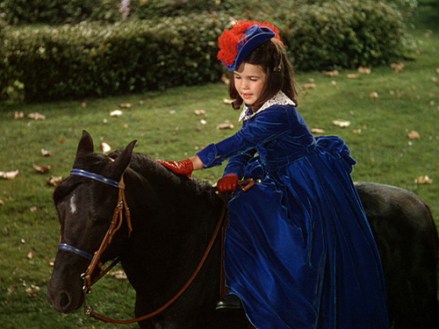
Two blockbuster movies hit the silver screen in 1939, The Wizard of Oz and Gone with the Wind. We all remember Dorothy’s iconic little dog in “Oz” a Carin Terrier named Toto. In “Gone” there were more than 1,100 horses used that in that production. Animals always add humanity our storytelling. Their actions can change a plot or slow down the pace of a well told tale. What many don’t know, is that in addition to both movies sharing director Victory Fleming, they also shared an animal actor, a little black pony named Admiral.
In Oz, his appearance was a brief role in Munchkinland. He was one of two small black ponies pulling a carriage, that Dorothy stepped into with her ruby slippers, in celebration of killing the Wicked Witch of the East. As Admiral and his handsome mate pulled the carriage around the circular beginnings to the yellow brick road, Munchkins broke into song with “Ding Dong! The Witch Is Dead!” So cute was Admiral with his gold-painted hooves and gleaming white harness, an ostrich feather atop his headstall. He did a great job of sending Dorothy off on her journey to the Emerald city.

Admiral pulling a carriage in Munchkinland in The Wizard of Oz
Later in 1939, Admiral made a larger supporting role in Gone with the Wind. He played a spirited pony, a gift from Rhett Butler to his young daughter Bonnie. We see young Bonnie mounted on Admiral sporting a beautiful blue velvet riding habit, complete with red leather gloves to match the red ostrich feather atop her matching blue velvet hat. Which, by the way, matched Admiral’s noseband and browband on his tanned leather bridle.

Bonnie Butler rides Admiral side saddle in Gone with the Wind
Bonnie, as spirited as Admiral, was telling her parents that she was going to show them how she could jump, a bigger jump than before. Scarlett, alarmed, pleaded with Rhett to make her stop, not to jump. He reminded Bonnie that she had just learned side saddle and perhaps wasn’t quite ready to attempt such a great feat. In defiance of her parents, off Bonnie canters fast towards the raised bar jump. And then we see Admiral’s crash, Bonnie’s fall and Scarlett’s scream.
Not a bad performance for a young Hollywood stunt pony. Admiral, who did his own stunts, was owned by Hollywood stunt man and animal trainer Dick Ryan. In a single year, his brief appearances in two of the most beloved movies of all time cemented his celebrity. And as has happened with other famous equines before and after him, his retirement years were bound to be filled with public appearances to his devoted fans.
Admiral Admiration
It was a sunny California morning as my Mom and I went shopping at the Del Monte Shopping Center in Monterey. We were there to visit my grandparents. My grandfather, editor of the Monterey Peninsula Herald newspaper, had arranged a trail ride for us at the famed Pebble Beach Golf Club. Back in the early 1970s, they had horses on the property and you could take them along the trails that meandered between the links and the Pacific Ocean. After that ride I was high on all things horsey, and a few days later we found ourselves in the Del Monte Center parking lot.
I spotted a little white horse trailer and dragged my Mom over to see what was in it. A tall man wearing a cowboy hat was backing a little black pony out of the trailer. I watched as the pony turned around and walked very gingerly on what seemed to me to be very long hooves. Almost with pointy toes, like Munchkin shoes.
“Why does he walk like that?” this inquiring pony crazy girl wanted to know.
“Founder,” cowboy hat man said.
“This is a very famous pony. He was in The Wizard of Oz and Gone with The Wind,” cowboy hat man beamed. “Would you like to pet him?”
As I walked toward equine Hollywood royalty, wide-eyed, arm outstretched, my palm landing on his soft neck. As I stroked him I asked cowboy hat man how old he was. “He’s 52!” Did I hear that right? I knew ponies could live long, but wow! He did look very old, especially the way he walked, but still. We stayed for a while, Mom grabbed my hand and we were off.

Paul Miles Schneider actually got to ride Admiral in a parking lot in the early 1970s – Dick Ryan walks beside him.
Recently, I came across Paul Miles Schneider’s blog that aged Admiral at 6 months old in 1939. This made a bit more sense to me, sort of. That would have made him 32 years old that day I met him in a parking lot. He was the same age as my Mom that day – she was born in 1939. And my pony Gingersnap had also lived to be 32, so I guess 32 makes more sense than 52. Funny, how we have childhood memories that really stick into our minds. But, I find it hard to believe that a 6-month-old pony could be trained to jump, crash into jumps, canter, be side-saddle broken, and trained to drive a carriage at such a young age. Sounds more like what a seasoned stunt pony of say maybe 20 years old might be capable of. Only Admiral knows for sure. But I tend to believe the cowboy hat man, Dick Ryan, the pony’s long time owner.
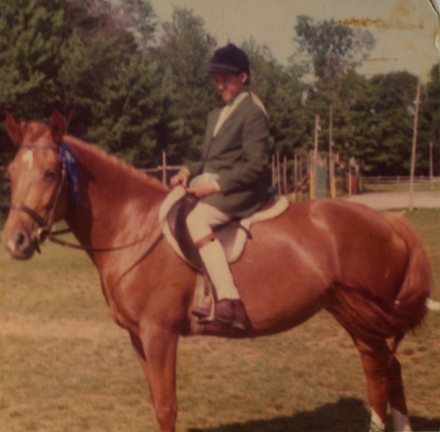
My chestnut pony Gingersnap first made the long journey with me to summer camp in New York’s Adirondack Mountains when she’d been in our family for just over a year. She was barely 4-years-old. I was 12. Loaded into an open-sided flatbed truck for the trip North, I met her a few days later at Camp MacCready. This sister camp to Camp Pok-O-Moonshine, a converted military boys camp, also clung to rituals like morning inspections, Sunday vespers and eating en masse in a mess hall. Fortunately, the girls camp had a horse program with its own rituals where I learned to ride just two seasons earlier.
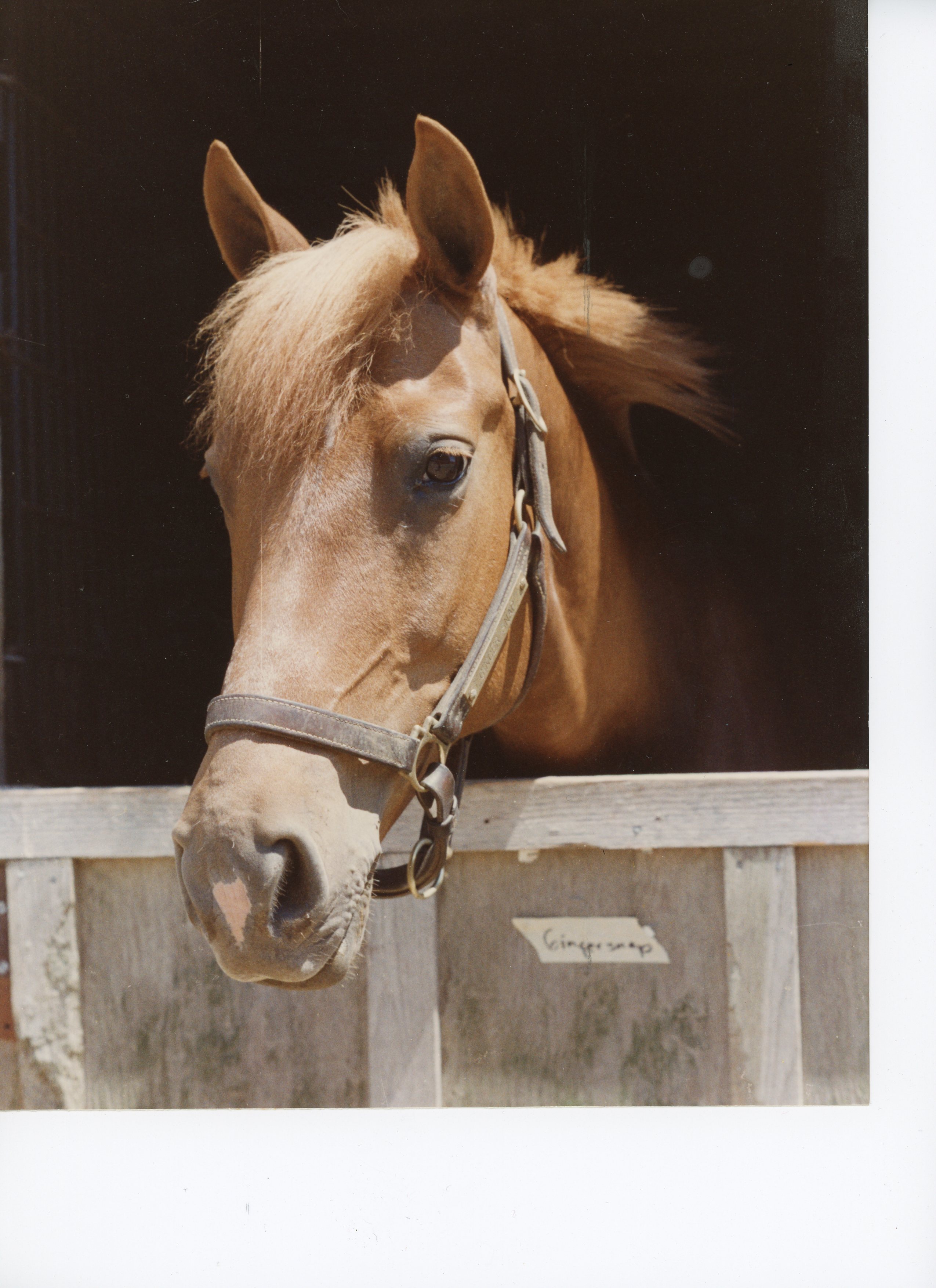
My chestnut pony Gingersnap
I’ve never been a morning person. Not even the lure of getting up early for a horse show works. So as a tween at camp, rolling out of my top bunk to join the other ‘horse masters’ to feed our hungry charges and muck manure-laden stalls, all before breakfast served precisely at 8 a.m., was a daunting task. Most mornings the head riding counselor would come get me out of bed, since all the horses had to be fed at the same time for fear of a barn riot. Eventually, my morning routine was established and my horsemanship skills, including pitchfork handling, wheelbarrow driving and manure pile management, improved.
As a barely saddle-broke pony, Ginger regularly bucked me off during our first year. Ring dirt and I were well acquainted. My parents had a teenager train her while I polished my stay-on skills on school horses. She had been sent to camp where counselors took over schooling her. So when we arrived, Ginger wasn’t my regular ride. By the end of summer, she was.

Ginger Strikes a Pose with Lisa at Camp
Pleasure Pony Dreams
As camp came to a close, we readied for the annual camp horse show. I was told I could ride Ginger in one flat class. My riding counselor entered us in the pleasure horse/pony class. “What? Pleasure? She’s the farthest thing from a pleasure pony,” was my young equestrian assessment. Despite protests, I laid out my show clothes and polished by brown paddock boots the night before. Meanwhile, a counselor tamed her long chestnut mane into tidy little braids held by brown yarn. I dreamed of a blue ribbon for my ‘pleasure’ pony.

Lisa and Ginger Share a Moment at Summer Camp
The next morning I bolted out of bed. By midday, our class was called and atop Ginger we boldly walked into the makeshift ring. Its outline marked by a fence of burnt orange wooden slats held together with wire, more suited for keeping back blowing snow than encircling show horses. We went though our paces to the left – walk, trot, canter – then reversed and executed the walk and trot to the right. On the far side of the ring the senior camper tents – worn green canvas perched on wooden platforms, most likely surplus from one of the world wars, I’m going to guess the first one – were softly flapping in the late summer breeze.
“All canter, please. All canter,” the ringmaster commanded. Once around the ring, pleasurably, we went. As Ginger rounded the far side of the ring, she decided flapping tents were scary. Bolt, buck, bounce, buck, and upon landing I heard the ringmaster, “All walk, please. All walk.” With a mighty upward pull of my right arm, left hand braced deep into those braids, I stopped her in mid third buck. Whew! What timing. I had her at the walk just at the right time. But I knew we’d blown our chance of being pinned a pleasure pony. “All line-up, numbers towards the judge please,” came the final instructions.
“In sixth place… fifth place…,” came the results from the loud speaker. By the time second place was announced I was ready to walk out of the ring. “In first place, number 22, Gingersnap!”

Blue Ribbon Pleasure Pony Gingersnap at Camp MacCready
“What? Pleasure? She’s the farthest thing from a pleasure pony,” was my young equestrian assessment. I had a confused look on my face as I turned towards the ringmaster to get my blue ribbon. To this day, I don’t know how we won that class. My young equestrian assessment was that the judge was rewarding me for staying on. My adult hindsight says the judge didn’t see our acrobatics, since the pleasure class is judged on the horse’s performance not the talent of the rider. Who knows? However, the faded Polaroid of that moment, with a blue ribbon tucked in her bridle and a silver plate clutched in my hand, remains once of my favorite images in the scrapbook of my summer camp career.
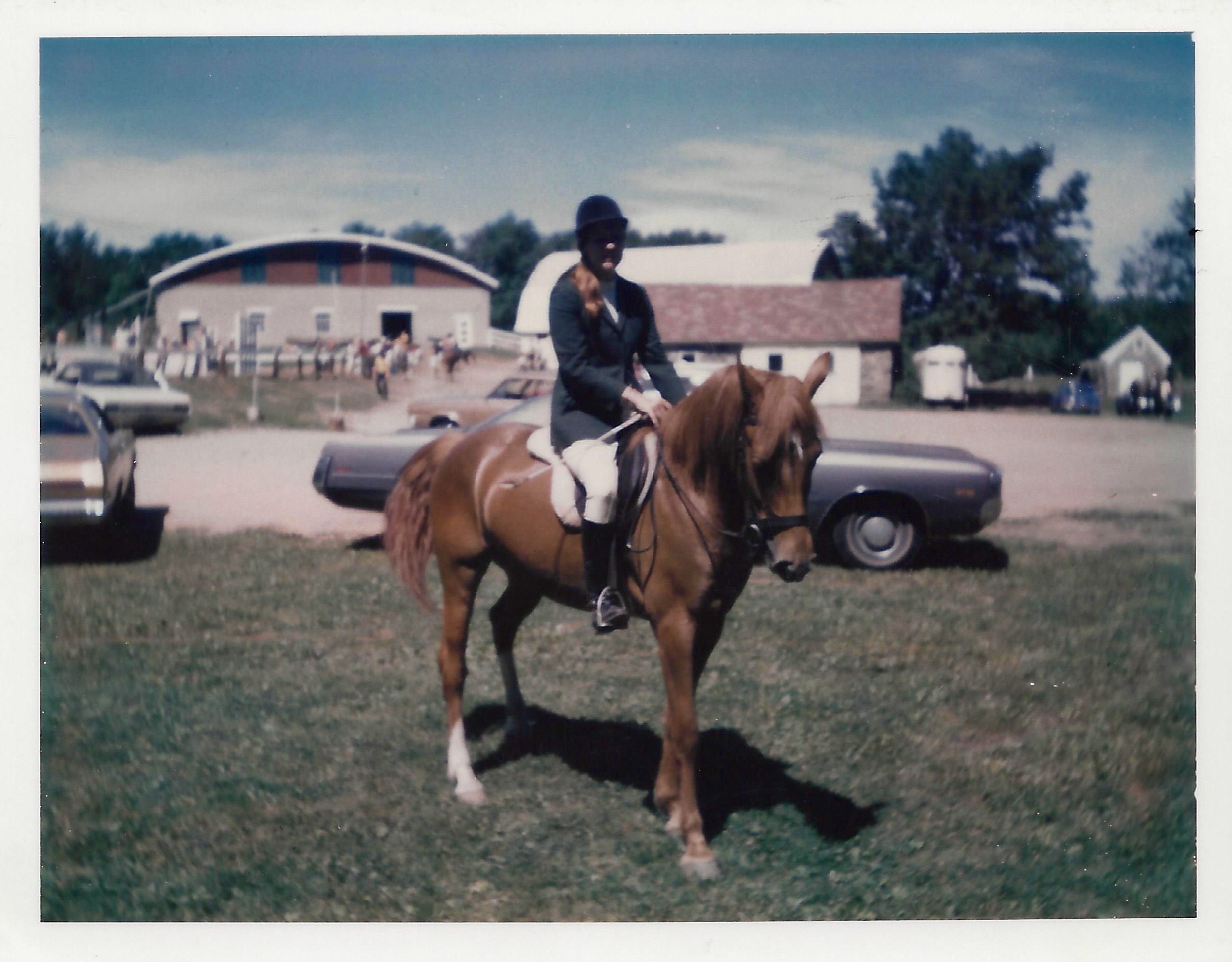
Even Mom showed Ginger at Horse Shows at Sweetbriar Farm
 Lisa Unleashed ~